
Modern cars are designed to protect more than just the people inside them. Over the past few decades, manufacturers have also changed the shape, structure and technology of vehicles to reduce the risk of serious injury to pedestrians.
These changes include softer, energy-absorbing bumpers, bonnets designed to provide more space above hard engine components and, on some vehicles, active bonnet systems that can lift the bonnet during a collision. Modern safety technology can also help prevent an impact altogether by detecting pedestrians and automatically applying the brakes when necessary.
Pedestrian protection has therefore become an important part of modern vehicle safety. Rather than relying on one feature, manufacturers combine changes to the physical design of the car with increasingly sophisticated collision-avoidance technology.
In this guide, we’ll look at how vehicle design has changed to protect pedestrians, how these features work and how modern cars are tested for pedestrian safety.
Why Pedestrian Safety Matters
Pedestrians are among the most vulnerable road users because they have no physical protection if they are struck by a vehicle. Even at relatively low speeds, a collision can result in serious injury.
Unlike drivers and passengers, pedestrians don’t have seatbelts, airbags or a vehicle structure surrounding them. This means the design of the vehicle they come into contact with can have a significant influence on the type and severity of injuries sustained.
Manufacturers have therefore increasingly designed the front of vehicles with pedestrian protection in mind. Bumpers, bonnets and other exterior components can be engineered to absorb more of the impact energy and reduce the forces transferred to a pedestrian.
Modern safety systems take this a step further. Cameras, radar and other sensors can help a vehicle detect pedestrians in its path, while systems such as autonomous emergency braking (AEB) may intervene if the driver doesn’t react in time.
Together, these developments have changed pedestrian protection from being purely about reducing injuries during a collision to also trying to prevent the collision from happening in the first place.
How Pedestrian Collisions Occur
When a pedestrian is struck by the front of a car, different parts of the vehicle can come into contact with different parts of the body. The precise sequence depends on factors such as the vehicle’s speed, height and shape, as well as the pedestrian’s position at the moment of impact.
The bumper may make the initial contact with the legs, while the upper body can subsequently come into contact with the bonnet, windscreen or surrounding structures.
This is why pedestrian protection involves more than simply making one part of a car softer. Manufacturers have to consider how the entire front of the vehicle behaves during an impact and where the greatest risks of injury are likely to occur.
Modern vehicle design therefore aims to manage impact forces across several areas of the car. Energy-absorbing bumpers can help reduce forces on the legs, while bonnet design and the space beneath it can help provide a more forgiving surface if a pedestrian’s upper body or head makes contact.
Preventing the collision remains the best outcome, which is why these physical design changes are increasingly combined with technologies such as pedestrian detection and autonomous emergency braking.
Vehicle Design Changes That Improve Pedestrian Safety
Softer, Energy-Absorbing Front-End Designs
One of the most important changes has been the development of vehicle fronts designed to absorb more energy during an impact.
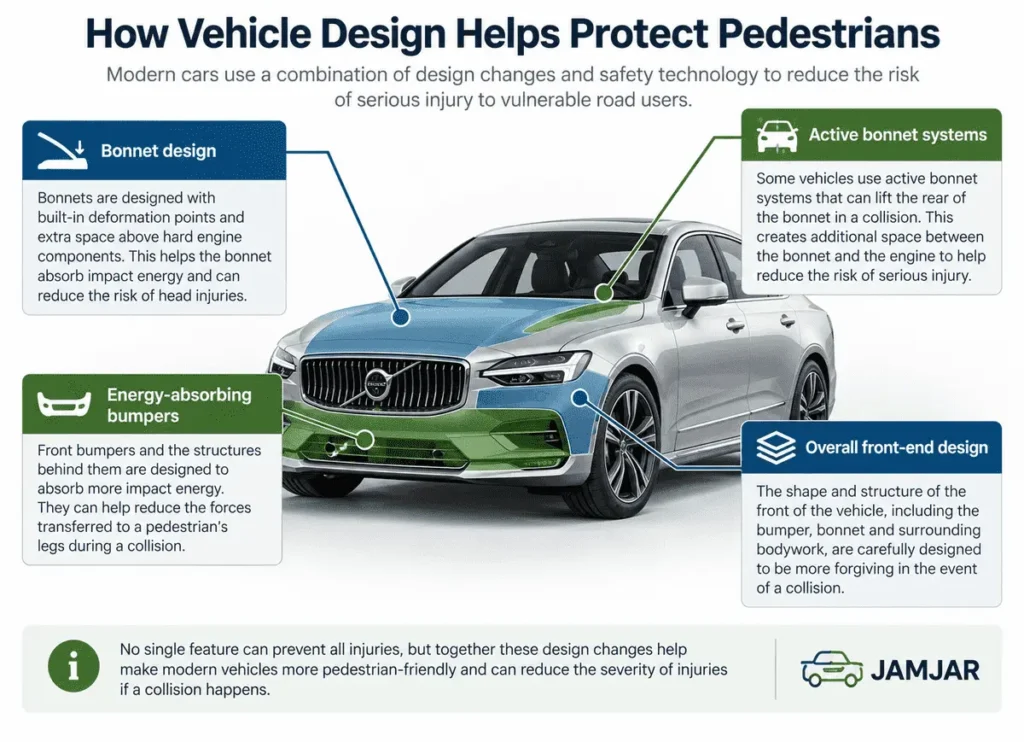
Modern bumpers and the structures behind them can incorporate deformable or energy-absorbing materials. Rather than presenting an unnecessarily rigid surface, these components are designed to manage some of the impact energy while still performing their normal structural and styling functions.
Pedestrian protection has also influenced the shape of the front of many vehicles. Manufacturers have to consider areas such as the bumper, bonnet leading edge and surrounding bodywork because each can make contact with a pedestrian during a collision.
The aim isn’t to make the front of a car simply “soft”. It is to control how different parts of the vehicle deform and absorb energy so that the forces transferred to a pedestrian can be reduced.
Bonnets Designed to Reduce Head Injuries
Bonnet design is particularly important because a pedestrian’s head or upper body may strike the bonnet during a collision.
A modern bonnet can be designed with sufficient clearance between its outer surface and harder components underneath, such as parts of the engine. This gives the bonnet space to deform during an impact and absorb some of the energy before the person comes into contact with the harder structures below.
Manufacturers can also use carefully engineered deformation points within the bonnet and its supporting structures to make the surface more forgiving during a pedestrian impact.
Some vehicles go a step further by using an active bonnet system. If sensors detect a pedestrian collision, actuators can rapidly raise the rear of the bonnet, creating additional clearance between the bonnet and the hard components beneath it.
The raised bonnet can then provide a greater area in which to deform and absorb energy, helping to reduce the severity of a potential head impact.
Bumpers Designed to Reduce Leg Injuries
A vehicle’s bumper is often one of the first parts of the car to make contact with a pedestrian, so its height, shape and construction can influence the forces placed on the legs during a collision.
Modern bumper systems can incorporate energy-absorbing structures behind the visible outer surface. These are designed to deform in a controlled way during an impact rather than transferring all of the force directly to the pedestrian.
Manufacturers also consider how the bumper interacts with the lower leg and knee. The aim is to reduce excessive forces and uncontrolled movement of the leg while still meeting the structural and everyday durability requirements of the vehicle.
Pedestrian safety testing has helped make this an important part of front-end vehicle development, rather than bumpers being designed purely around styling and protection of the car itself.
Windscreens, A-Pillars and Safer Exterior Components
Pedestrian protection doesn’t stop at the bumper and bonnet. Depending on the circumstances of a collision, a pedestrian’s head or upper body may also come into contact with the windscreen, the edges of the bonnet or the pillars surrounding the glass.
Manufacturers therefore have to consider the potential impact areas across the wider front of the vehicle and identify particularly rigid structures that could increase the risk of injury.
Windscreen design, bonnet hinges, wiper mechanisms and other components can all influence how forgiving an impact area is. Where possible, manufacturers can position or engineer components to reduce the likelihood of a pedestrian striking an unnecessarily hard structure.
Some areas, particularly the A-pillars supporting either side of the windscreen, still need considerable structural strength to protect the vehicle’s occupants. This demonstrates one of the challenges of modern car design: manufacturers have to balance pedestrian protection with crash protection for the people inside the vehicle.
Rather than relying on a single safety feature, modern pedestrian protection is therefore the result of many individual design decisions working together across the front of the car.
Technology That Helps Prevent Pedestrian Collisions
Vehicle safety has moved beyond purely physical design improvements.
Many modern cars now feature active safety technologies designed to prevent collisions altogether.
Pedestrian Detection Systems
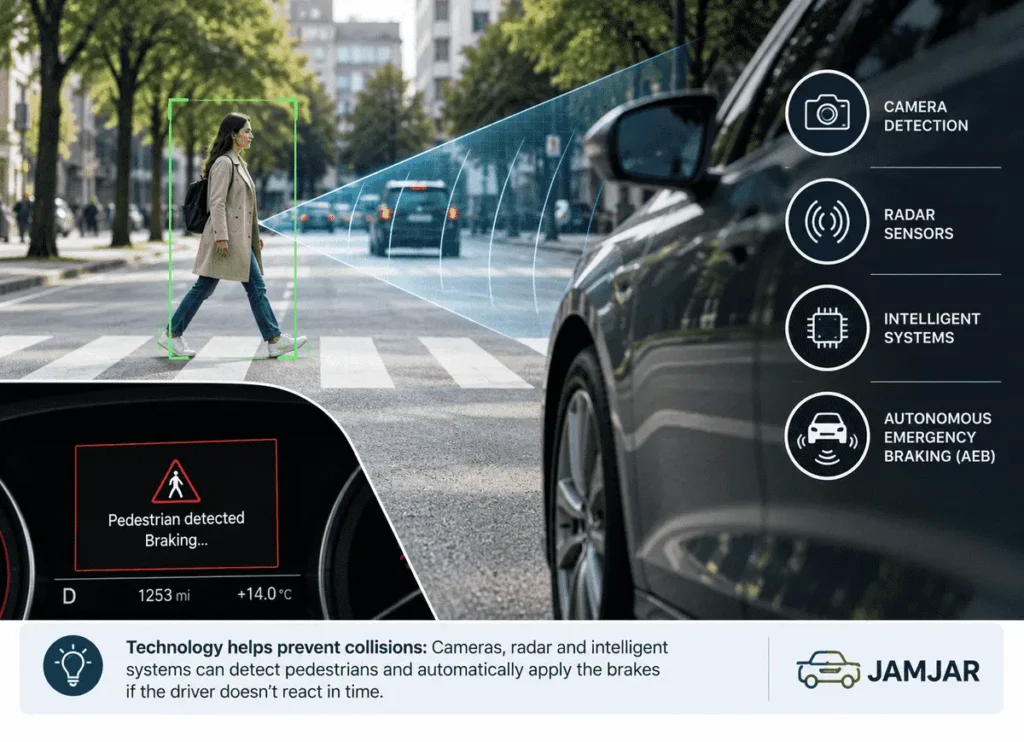
Modern cars can use cameras, radar and other sensors to monitor the road ahead and identify pedestrians who may be in or approaching the vehicle’s path.
The system continually analyses information from these sensors and, when it detects a potential collision risk, can warn the driver through visual, audible or other alerts.
Pedestrian detection is particularly useful because people can move into the road unexpectedly and may be more difficult to spot in busy environments. However, these systems have limitations and their performance can be affected by factors such as visibility, weather and the particular technology fitted to the vehicle.
They are therefore designed to assist the driver rather than replace careful observation and responsible driving.
Autonomous Emergency Braking (AEB)
Autonomous emergency braking, commonly known as AEB, can take pedestrian detection a step further.
If the vehicle detects a potential collision and the driver doesn’t respond sufficiently, the system can automatically apply the brakes. Depending on the circumstances, this may help avoid the collision altogether or reduce the vehicle’s speed before impact, potentially reducing the severity of any injuries.
Not every AEB system has the same capabilities. Some systems are specifically designed to detect pedestrians and cyclists as well as other vehicles, while their operating speeds and effectiveness can vary between cars.
This makes AEB an important development in pedestrian safety because vehicle technology is no longer focused solely on protecting somebody during a collision. Increasingly, the car can also help the driver avoid that collision in the first place.
AEB is now fitted to many modern vehicles, but different systems can have different capabilities. Find out more in our guide to how autonomous emergency braking works.
Smarter Cameras, Radar and Vehicle Sensors
Improvements in cameras, radar, sensors and the software interpreting their data have made modern driver-assistance systems increasingly capable of recognising hazards around the vehicle.
Combining information from different sensors can help a vehicle assess the position and movement of pedestrians and determine whether there is a developing collision risk.
These technologies also support other driver-assistance features, but their capabilities vary considerably between vehicles. Drivers should always understand what the systems fitted to their particular car can — and cannot — do.
As sensor and software technology continues to develop, pedestrian protection is increasingly becoming a combination of safer physical vehicle design and active collision-avoidance technology.
Research and Testing Driving Safer Designs
Changes to pedestrian-friendly vehicle design haven’t happened by accident. Crash research, safety regulation and independent vehicle testing have encouraged manufacturers to consider how a car protects vulnerable road users as part of its overall safety performance.
Engineers can use computer modelling, laboratory testing and physical impact tests to study what happens when different parts of a vehicle come into contact with a pedestrian. The results can then influence the design of bumpers, bonnets, windscreens and active safety systems.
Euro NCAP and Vulnerable Road User Testing
Euro NCAP — the European New Car Assessment Programme — assesses how well new vehicles protect vulnerable road users as part of its safety testing.
Testing examines the potential injuries that could result when different parts of a pedestrian’s body make contact with areas of the vehicle such as the bumper, bonnet and windscreen. This helps identify parts of the vehicle that provide better protection and areas where particularly rigid structures could increase the risk of injury.
Modern assessments also consider collision-avoidance technology. Systems designed to detect pedestrians and cyclists can be tested to see how effectively a vehicle responds in different scenarios and whether autonomous emergency braking can help prevent or reduce the severity of a collision.
This is important because pedestrian safety can now influence the overall safety assessment of a new car. Manufacturers therefore have a strong incentive to consider vulnerable road users during the vehicle-development process rather than treating pedestrian protection as an afterthought.
Learning From Real-World Collisions
Laboratory testing can reproduce specific collision scenarios, but real-world accident data also helps researchers understand how pedestrians are injured outside controlled test conditions.
Studying actual collisions can reveal recurring injury patterns, the parts of vehicles most commonly involved and circumstances in which existing safety systems may be less effective.
This information can feed back into vehicle development, helping manufacturers and safety organisations identify where further improvements may be needed.
The combination of controlled testing, real-world collision research and developing safety technology has helped pedestrian protection become an established part of modern vehicle design.
The Future of Pedestrian-Safe Vehicle Design
Pedestrian protection will continue to develop as vehicle sensors, software and safety systems become more sophisticated.
Future systems may become better at identifying pedestrians earlier, predicting how vulnerable road users are likely to move and responding to more complex situations. Improvements to cameras, radar and other sensing technologies could also help safety systems operate more effectively in difficult conditions.
Communication between vehicles and other road users may eventually play a greater role too. Connected technology has the potential to warn vehicles about hazards that their own sensors cannot yet see, although the availability and capabilities of these systems will depend on how the technology develops.
Physical vehicle design will remain important alongside these advances. Better collision-avoidance technology can reduce the likelihood of an impact, while carefully engineered bumpers, bonnets and other exterior structures can help reduce injuries when a collision cannot be avoided.
The direction of travel is therefore clear: pedestrian safety is increasingly about combining collision prevention with injury reduction, rather than relying on either approach alone.
Are Modern Cars Safer for Pedestrians?
Modern cars can offer significantly more pedestrian-protection technology than vehicles designed before vulnerable road-user safety became an important part of vehicle development and testing.
Features such as energy-absorbing front structures, pedestrian-friendly bonnet designs, active bonnet systems, pedestrian detection and AEB demonstrate how much the approach has changed.
However, the level of protection varies between individual cars. A newer vehicle isn’t automatically better in every pedestrian-safety scenario, so independent safety-test results can be useful when comparing different models.
Most importantly, these technologies don’t remove the driver’s responsibility to watch for pedestrians and drive appropriately for the conditions. The best pedestrian collision is still the one that never happens.
Understanding the safety systems and technology fitted to your car is part of getting to know the vehicle you own. For more advice on looking after and understanding your vehicle, explore our car maintenance guidance.
If you’re considering changing your car and want to know what your current vehicle could be worth, get a free online car valuation from jamjar.