
Did you know a telematics box — often called a black box — could help reduce the cost of your car insurance by allowing an insurer to assess how you actually drive?
A telematics box is a small electronic device that records information about your driving, such as your speed, acceleration, braking, cornering and when you use the car. This information is sent to your insurer and can be used to calculate a driving score and assess the level of risk you present.
Black box insurance is particularly popular with young and newly qualified drivers, who often face higher insurance premiums. Driving safely may help reduce the cost of cover, although savings aren’t guaranteed and the way your driving is assessed varies between insurers.
Despite the name, telematics insurance doesn’t always require a physical box to be fitted to your car. Some policies now use a smartphone app, plug-in device or other tracker instead.
Below, we’ll explain how telematics works, what information it records, how it can affect your insurance costs and whether a black box policy could be right for you.
How does a telematics box work?
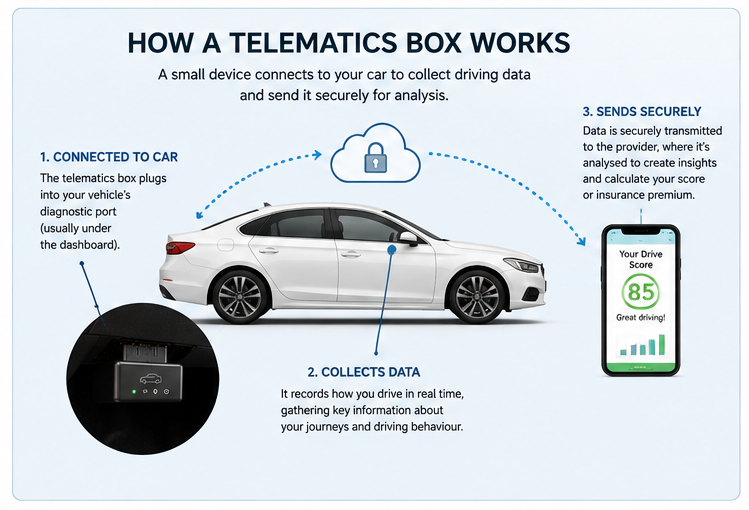
A telematics box works by recording information about how and when your car is being driven. Depending on the policy, this may be done through a physical black box fitted to the vehicle, a plug-in device or a smartphone app.
The technology can use GPS together with other sensors to build a picture of your driving. Information is then sent securely to the telematics provider or insurer, where it can be used to calculate a driving score.
Rather than looking at one journey in isolation, insurers can assess your driving behaviour over time. Depending on the policy, this information may influence your premium, renewal price or whether the insurer is prepared to continue providing cover.
Many telematics policies also give you access to your driving information through an app or online account, allowing you to see your score and identify areas where your driving could improve.
Some telematics devices can provide additional features such as helping to locate a vehicle if it is stolen, although the exact features vary between providers.
Does black box insurance work with any car?
Black box insurance is available for a wide range of cars, but whether your particular vehicle is suitable will depend on the insurer and the type of telematics technology it uses.
Some policies require a physical black box to be professionally fitted to the car, while others use a plug-in device, technology already built into the vehicle or a smartphone app.
This means you shouldn’t assume that every telematics policy will work with every vehicle. Certain cars may not be compatible with a particular device or insurer’s requirements.
Before taking out a policy, check that your exact make and model is eligible and whether any equipment needs to be fitted. Your insurer should also explain what happens to a fitted device if you change car or cancel the policy.
What data does a telematics box collect?
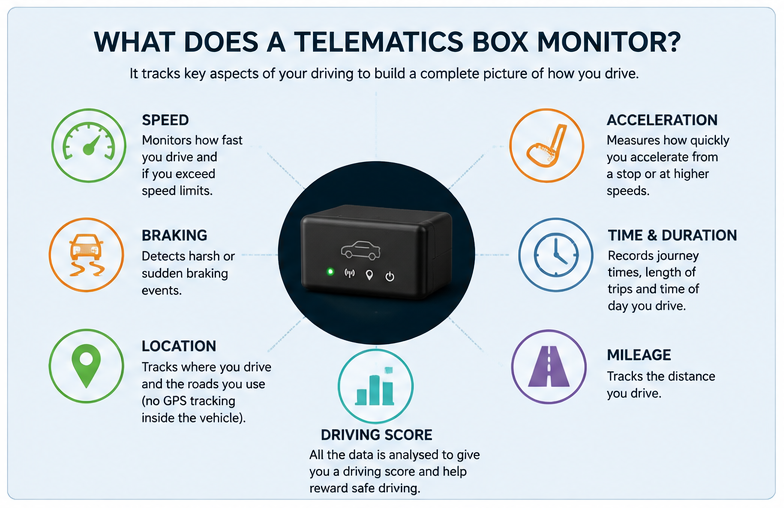
The exact information collected depends on your insurer and the type of telematics policy you have. However, a black box may monitor things such as:
- Speed – including how fast you drive and, depending on the system, how this compares with road conditions or speed limits.
- Acceleration – repeated rapid acceleration may affect how your driving is assessed.
- Braking – frequent harsh braking can be used as an indication of driving behaviour.
- Cornering – some systems can detect particularly sharp or aggressive cornering.
- Mileage – your insurer may record how far you drive and whether this matches the mileage agreed on your policy.
- When you drive – some policies take account of the times of day or night that the vehicle is being used.
- Journey information – depending on the system, this can include when and where journeys take place.
Your insurer will normally combine this information over time to build a picture of your driving rather than judging you on a single journey. Exactly how the data affects your driving score or insurance premium will depend on the terms of your policy.
Because telematics information can relate to an identifiable driver, it can also be personal data and is subject to UK data-protection law. Your insurer should explain what information is collected, how it is used and who it may be shared with.
How much does telematics insurance cost?
The cost of telematics insurance varies depending on several factors, including:
- Your age and driving experience
- Your vehicle
- Where you live
- Your annual mileage
- Your driving score
Driving safely can reduce your premium over time, while consistently speeding or braking harshly could increase your renewal price.
Like traditional insurers, telematics providers may also charge administration fees for policy changes.
Is telematics insurance cheaper than standard insurance?
There isn’t a fixed price for telematics insurance. Like standard car insurance, the cost of your policy will depend on factors such as:
- Your age and driving experience
- The car you drive
- Where you live
- Your annual mileage
- Your claims and driving history
- The level of cover you choose
The difference with a telematics policy is that information about how you drive may also affect what you pay. Depending on the insurer, safer driving could help you qualify for a lower premium or a better renewal price, while consistently risky driving could increase your costs.
It’s also important to check for additional charges. Some black box policies may charge for installing or removing the telematics device, and there could be a fee if you cancel the policy early. Other policies use an app or different technology and may not have the same costs.
Always compare the total cost of the policy, rather than assuming that black box insurance will automatically be cheaper.
Can a telematics box help after an accident?
Yes. Some telematics devices can detect when a collision occurs.
The recorded data may provide useful information about:
- Vehicle speed
- Braking before impact
- Time and location of the incident
In some cases, insurers may use this information when investigating an accident or determining liability.
If you’re interested in more car technical terms, you might be interested in finding out all about what a no claims discount is, if you’re not familiar with this term already.
Who is telematics insurance best for?
Telematics insurance is particularly popular with young and newly qualified drivers, because they often face some of the highest car insurance premiums. A black box policy gives them an opportunity to demonstrate their individual driving behaviour rather than being assessed entirely on broader risk factors associated with their age and experience.
However, telematics insurance isn’t only for young drivers. It may also be worth considering if you:
- Are a careful driver who is comfortable having your driving monitored
- Have relatively little driving experience
- Drive a relatively low annual mileage
- Are facing particularly expensive standard insurance quotes
- Want feedback that could help you improve your driving habits
That doesn’t mean a telematics policy will automatically be the cheapest choice. Different insurers measure driving behaviour differently, and some policies may include mileage limits, restrictions or additional charges that won’t suit every driver.
Before choosing one, compare the overall price and policy terms with standard car insurance and make sure you understand what is monitored, how your driving score affects the policy and whether any restrictions apply.
If you’re shopping around for cover, it’s also worth knowing the warning signs of insurance quotes that seem too good to be true.
Can a telematics box increase your insurance?
Yes. Depending on the terms of your policy, telematics data can sometimes lead to higher insurance costs if your driving is consistently assessed as higher risk.
For example, an insurer may take account of repeated harsh braking or acceleration, speeding, frequent late-night driving or other behaviour covered by its scoring system. Exactly what is measured — and how much each factor matters — varies between insurers.
Some telematics policies can adjust premiums during the policy, while others may use your driving score when calculating your renewal price. In more serious cases, consistently poor driving scores can result in warnings and, where the policy terms allow it, the insurer may ultimately cancel the policy.
This is why it’s important to understand how your particular policy scores your driving and what the consequences of a low score can be before taking out black box insurance.
If rising insurance costs, repairs or running expenses are making your car expensive to own, it’s worth finding out what it’s currently worth. Get a free, no-obligation valuation with jamjar’s value my car service.