
If you’ve seen a used car described as Category N, or Cat N, it means the vehicle has previously been written off but the damage was assessed as non-structural.
That doesn’t necessarily mean the damage was minor. A Category N vehicle may still have suffered significant damage, including to safety-critical components, even though its structural frame or chassis was not damaged.
Category N cars can be repaired and returned to the road, which means they regularly appear on the used-car market. But their history can affect their value, insurance and how easily they may be sold again.
If you’re considering buying or selling one, understanding exactly what Category N means — and checking the quality of any repairs — is important.
For more advice about repairs and keeping a vehicle roadworthy, visit our car maintenance guidance.
What Does It Mean When a Car Is Written Off?
A vehicle is written off when an insurer decides it should be treated as a total loss rather than repaired as part of the insurance claim.
Often this happens because repairing the vehicle would not be economically worthwhile compared with its pre-accident value. A vehicle can also be considered unsuitable or unviable to repair because of the nature or severity of its damage.
In the UK, insurance write-offs are divided into four main salvage categories:
- Category A — Scrap: the entire vehicle must be crushed and cannot return to the road.
- Category B — Break: the body shell must be crushed, although suitable parts may be recovered and reused.
- Category S — Repairable Structural: the vehicle has sustained structural damage but can be repaired.
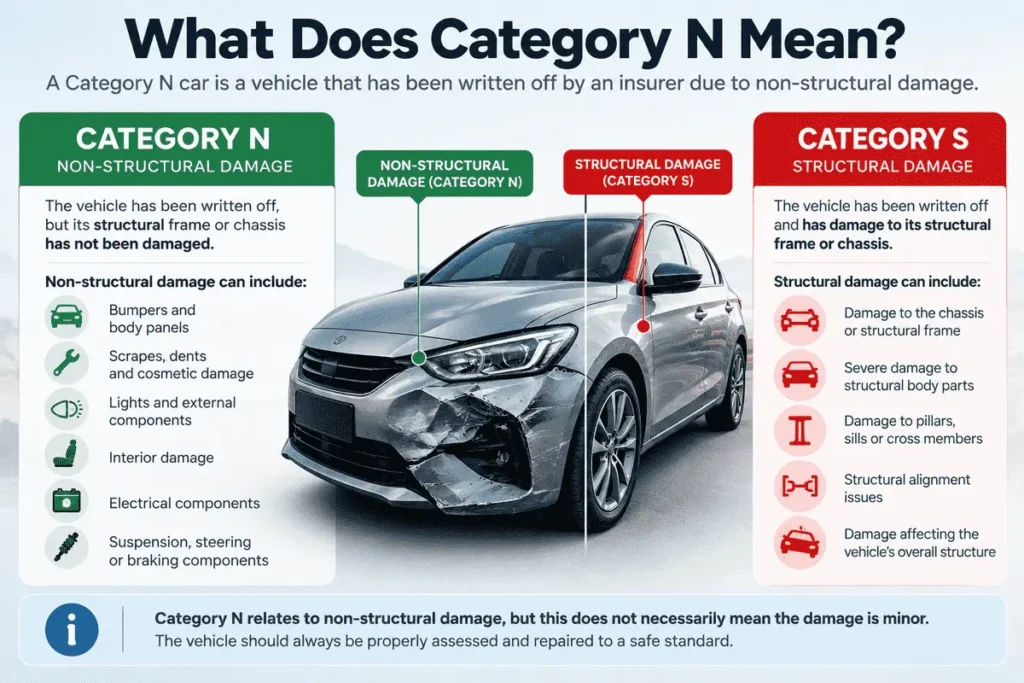
- Category N — Repairable Non-Structural: the vehicle has not sustained damage to its structural frame or chassis and can be repaired.
Category S and Category N vehicles can return to the road once repaired to a roadworthy condition. Category A and B vehicles cannot.
What Is a Category N Car?
A Category N car is a repairable insurance write-off that has not sustained damage to its structural frame or chassis.
The “N” stands for non-structural, but that should not be confused with “minor”.
Depending on the incident, damage could involve body panels, bumpers, lights, electrical systems, steering, suspension, braking components or other parts of the vehicle.
Importantly, the ABI’s Salvage Code states that although a Category N vehicle’s damage is classified as non-structural, safety-critical components may still require replacement.
A Category N car can return to the road, but it must be repaired to a roadworthy condition before it is used.
Why Does Category N Matter?
A Category N classification becomes an important part of the vehicle’s history.
It doesn’t automatically mean the car is unsafe or a bad vehicle. A properly repaired Category N car can legally return to the road and may provide good value for the right buyer.
However, its previous write-off status can affect its market value and may make some future buyers more cautious.
The quality of the repairs therefore matters enormously. Two Category N cars with apparently similar histories could be very different propositions depending on the original damage, how well it was repaired and what evidence exists for the work carried out.
How Do You Know If a Car Is Category N?
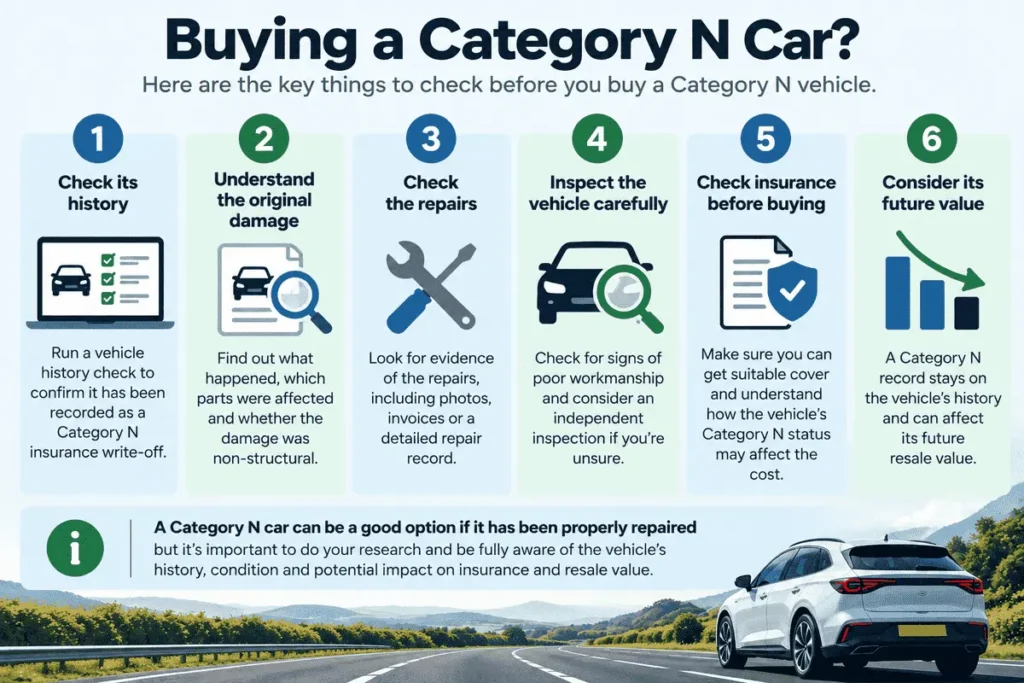
Before buying any used vehicle, it’s worth checking its history.
A vehicle history check can help identify whether a car has previously been written off and may also reveal other useful information, including:
- It has previously been written off
- It has outstanding finance
- The mileage appears consistent
- It has been reported stolen
- There are any significant issues recorded against it
A history check doesn’t tell you whether repairs have been carried out well, so it should be used alongside an inspection of the vehicle and any available repair documentation.
Buying or Selling a Category N Car
Category N cars can sometimes offer good value because their previous write-off status will often make them cheaper than an equivalent vehicle without that history.
But price alone shouldn’t determine whether one is worth buying.
Before buying a Category N car, consider:
- What damage caused the vehicle to be written off.
- Who carried out the repairs.
- Whether invoices, photographs or other evidence of the repair are available.
- The vehicle’s service and MOT history.
- Its current mechanical and cosmetic condition.
- Whether you’re happy with the likely effect on its future resale value.
An independent inspection can also be worthwhile if you’re uncertain about the quality of the repairs.
If you’re selling a Category N car, be clear about its previous write-off status. Providing repair invoices, photographs or other supporting documentation can help a prospective buyer understand what happened to the vehicle and how it was repaired.
Does Insurance Cost More?
Not necessarily, but insuring a Category N car can sometimes be more complicated.
Insurers assess risk differently, so some may insure a previously written-off vehicle on broadly similar terms to another car, while others may charge more or apply different conditions.
The premium will still depend on the usual factors such as the driver, vehicle, location, level of cover and claims history, as well as the insurer’s approach to previously written-off vehicles.
If you’re considering buying a Category N car, it’s sensible to obtain an insurance quote before completing the purchase and make sure the insurer knows about the vehicle’s history.
Does Category N Affect the MOT?
A Category N classification does not automatically mean a car needs a new MOT simply because it has been written off.
However, the vehicle must still be roadworthy before it is driven on public roads, and any damage affecting items covered by the MOT could obviously cause it to fail when tested.
An MOT certificate should also not be treated as proof that previous accident repairs were completed to a high standard. If you’re buying a Category N vehicle, the repair history and condition of the car still need to be considered separately.
What Are the Disadvantages of Buying a Category N Car?
A well-repaired Category N car can be perfectly usable, but there are disadvantages to consider before buying one.
These can include:
- A lower future resale value.
- Some buyers being reluctant to purchase it when you eventually sell.
- Potentially fewer insurance options or different insurance terms.
- Uncertainty about the quality of previous repairs if documentation is limited.
- The Category N history remaining associated with the vehicle.
The lower purchase price can compensate for these disadvantages for some buyers, particularly when the original damage and subsequent repairs are well documented.
For others, paying more for a vehicle without a previous write-off history may provide greater peace of mind.
Are Category N Cars Worth Less?
Generally, yes. A Category N car will usually be worth less than an otherwise comparable vehicle that has not previously been written off.
There isn’t a reliable percentage that applies to every Category N car. The difference in value will depend on factors including:
- The make and model.
- Age and mileage.
- The nature of the original damage.
- The quality of the repairs.
- Evidence documenting those repairs.
- Overall condition and service history.
- Current market demand.
Even after excellent repairs, buyers are likely to take the vehicle’s recorded write-off history into account when deciding what they’re prepared to pay.
The same consideration applies when you eventually sell the vehicle, so a cheaper purchase price should be weighed against its potentially lower future resale value.
It’s also worth reading our guide to What Is an HPI Check?, which explains how to check whether a used vehicle has previously been written off before you buy.
Can You Remove a Category N Marker?
A genuine Category N write-off forms part of the vehicle’s recorded history and repairing the vehicle does not simply remove that history.
This is important when buying or selling because the car should continue to be valued and described with its previous write-off status taken into account.
If you believe a vehicle has been incorrectly recorded as a write-off, that is a different situation and should be raised with the insurer or relevant data provider rather than simply assuming the marker can be removed.
If you’d like to understand the other categories too, our guide to Car Write Offs explains more about the different insurance write-off classifications.
Find Out What Your Car Is Worth
If you’re thinking about selling a Category N car, its previous write-off history is one of the factors that can affect what buyers are prepared to pay.
Use jamjar’s Value My Car tool to get a free online valuation and understand what your vehicle could be worth today.