
BMW CEO Oliver Zipse has long argued that policymakers should avoid relying on a blanket ban on combustion-engine technology as the only route towards lower-emission motoring. Instead, he has advocated a technology-neutral approach that leaves room for alternatives alongside battery-electric vehicles.
Several years later, that argument is worth revisiting. Governments and car manufacturers are still committed to moving towards zero-emission vehicles, but the debate around how quickly combustion engines should disappear — and whether technologies such as e-fuels have a role to play — continues to evolve.
If you’re exploring your options as the automotive landscape evolves, our car valuation guidance hub offers practical advice for drivers navigating these changes.
The Case for E‑Fuels
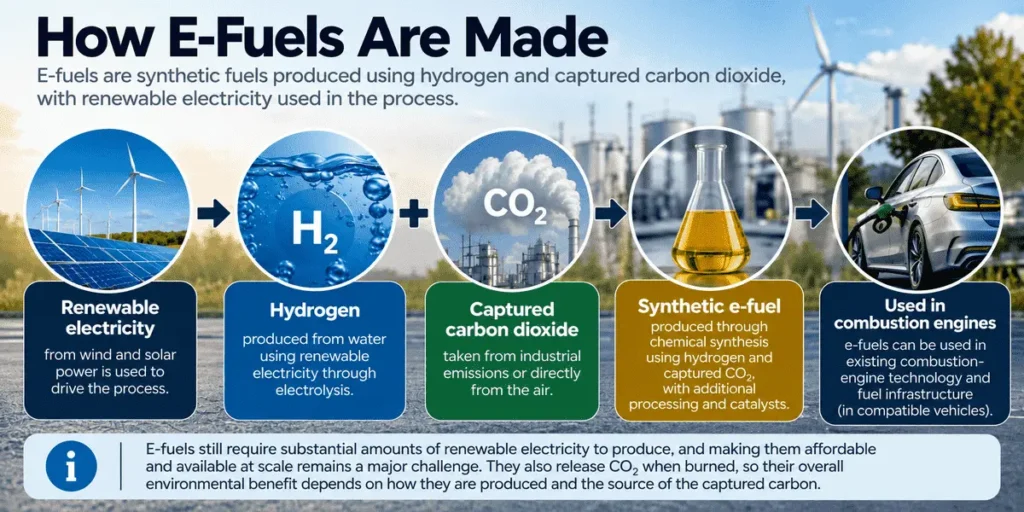
E-fuels are synthetic fuels that can potentially be used in combustion engines. They are typically produced using hydrogen and captured carbon dioxide, and supporters argue that when renewable energy is used in their production, they could reduce the lifecycle carbon impact of vehicles that are difficult to electrify.
One attraction is that liquid e-fuels could potentially be used with existing combustion-engine technology and fuel infrastructure. However, producing them requires substantial amounts of electricity, and making them affordable and available at scale remains a major challenge. For passenger cars, battery-electric vehicles are therefore expected to remain central to the transition away from fossil fuels.
The transition is already influencing the decisions manufacturers make about the cars they sell. Our guide to how government EV sales targets are changing the car market looks at how those targets are affecting the industry.
The Debate Around a Combustion Engine Ban
Supporters of phasing out new combustion-engine cars argue that clear deadlines give manufacturers certainty to invest in electric vehicles, batteries and charging infrastructure while helping governments reduce transport emissions.
Critics argue that governments should set emissions targets rather than prescribe a single technology. Their concern is that ruling out combustion engines completely could remove future options such as e-fuels or other low-carbon technologies before their potential is fully understood.
Zipse’s argument has broadly followed this second approach. He has supported electrification while questioning whether legislation should make battery-electric vehicles the only permitted technological solution. The distinction is important: the debate is not simply between electric cars and petrol cars, but also about how governments achieve lower emissions and how much flexibility manufacturers should retain in getting there.
For drivers considering the move away from a combustion-engine car themselves, our guide to buying a used electric vehicle looks at some of the practical considerations involved in choosing a second-hand EV.
A Balanced Transition
The policy landscape has continued to evolve since Zipse first made his argument. In the UK, the government plans to end sales of new cars powered solely by petrol or diesel in 2030, while allowing some hybrid vehicles to remain on sale until 2035. The longer-term aim remains for all new cars and vans to be zero-emission by 2035.
What happens between now and then will depend on factors including EV affordability, charging infrastructure, battery development and the ability of manufacturers to meet changing emissions rules. Technologies such as e-fuels may also have a role in particular applications, although their eventual importance to mainstream passenger cars remains uncertain.
So was Zipse right? His warning that the transition would be more complicated than simply choosing one technology has remained relevant. That does not mean the move towards electric vehicles has stopped; rather, the debate continues over how quickly it should happen and whether other technologies should retain a place alongside electrification.
Thinking About Finding Out Your Car’s Value?
Whether you’re considering an electric vehicle, a hybrid, or sticking with a petrol or diesel car for now, understanding your vehicle’s current value can help you plan your next move.
You can use our car valuation service to get an estimate of what your current car could be worth before deciding what comes next.