
For more than five decades, the Ford RS badge has been attached to some of the company’s most exciting performance cars. Born from Ford’s involvement in motorsport, RS — short for Rallye Sport — became associated with cars designed to bring competition-inspired performance to the road.
From the early Escort RS models to the extraordinary mid-engined RS200, the Sierra and Escort RS Cosworth and eventually the Focus RS, the badge has appeared on some of Ford’s most memorable performance cars.
What makes the RS story particularly interesting is how much the cars changed over the decades. Some were created with motorsport firmly in mind, while later models brought serious performance to practical road cars that could still be used every day.
Visit our valuation guidance hub for more performance-car history, buying guides and motoring features.
The Birth of Ford RS
Ford’s RS story stretches back to 1968, when the company introduced the 15M RS in Germany. However, it was the Escort RS1600, launched in 1970, that really established the formula that would define Ford RS for decades to come.
RS stood for Rallye Sport, reflecting the close relationship between Ford’s competition programme and its high-performance road cars.
The Escort RS1600 used an advanced 1.6-litre BDA engine developed with Cosworth, featuring a 16-valve cylinder head and twin overhead camshafts. For 1970, this was seriously sophisticated technology.
The RS1600 quickly proved itself in competition, including victory in the 1972 East African Safari Rally, helping establish the RS badge as something far more significant than a styling package.
Ford soon expanded the idea to other performance models, including the Capri RS2600 and later Escort RS variants. From the beginning, the RS philosophy was about using motorsport and advanced engineering to create faster, more capable road cars.
Ford Escort RS2000: Taking RS to the Road
While the RS1600 demonstrated what Ford could achieve by combining road cars with competition engineering, the Escort RS2000 helped make the RS badge familiar to a much wider audience.
Introduced in the early 1970s, the original RS2000 used Ford’s 2.0-litre Pinto engine. It offered strong performance without being as highly strung as some of the more competition-focused Escort models, making it particularly well suited to everyday road use.
A second-generation Escort RS2000 followed in 1975 and became one of the most recognisable sporting Escorts of the era. Its distinctive sloping polyurethane nose helped separate it visually from ordinary Escort models, while rear-wheel drive and relatively low weight gave it the kind of entertaining handling for which fast Fords became famous.
The RS2000 demonstrated an important part of the RS formula: Ford didn’t necessarily need to build an exotic supercar to create an exciting performance car. Taking an affordable mainstream model and transforming it into something enthusiasts genuinely wanted would become a recurring theme throughout RS history.
Ford RS200: The Group B Legend
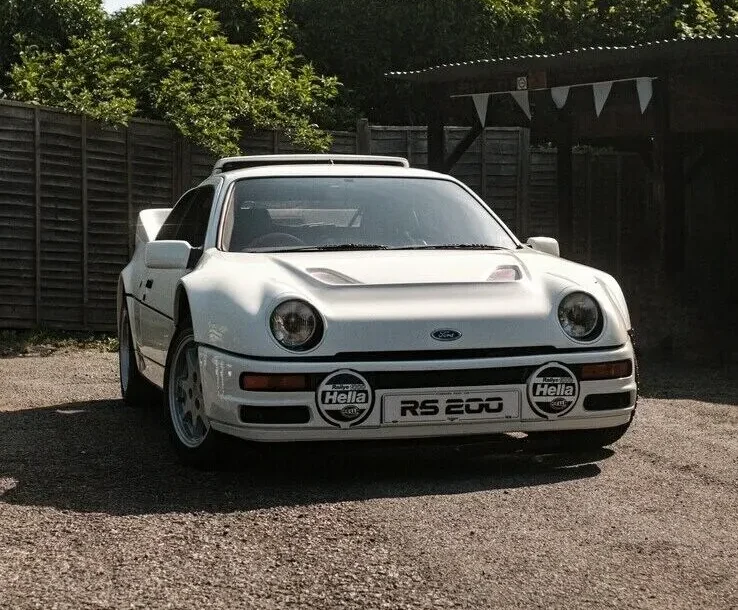
Few cars demonstrate Ford’s motorsport ambitions better than the RS200. Developed specifically for the spectacular Group B rally regulations of the 1980s, it was completely different from the everyday Ford models that had previously worn the RS badge.
Instead of adapting an existing production car, Ford created a purpose-built, mid-engined four-wheel-drive machine. Its lightweight composite bodywork covered a turbocharged 1.8-litre engine developed by Cosworth, with road-going versions producing around 250 bhp.
Competition versions were considerably more powerful, while the later RS200 Evolution was developed to produce substantially higher outputs as Ford pushed the car’s rallying potential even further.
Group B was cancelled at the end of the 1986 season, bringing the RS200’s intended competition career to an early end. Only around 200 road-going examples were produced to meet homologation requirements, helping make it one of the rarest and most distinctive cars ever to carry an RS badge.
Although its rally career was brief, the RS200 demonstrated just how far Ford was prepared to go in pursuit of performance. Even today, it remains one of the most extraordinary cars in the company’s history.
Sierra RS Cosworth: A New Era of Turbocharged Performance
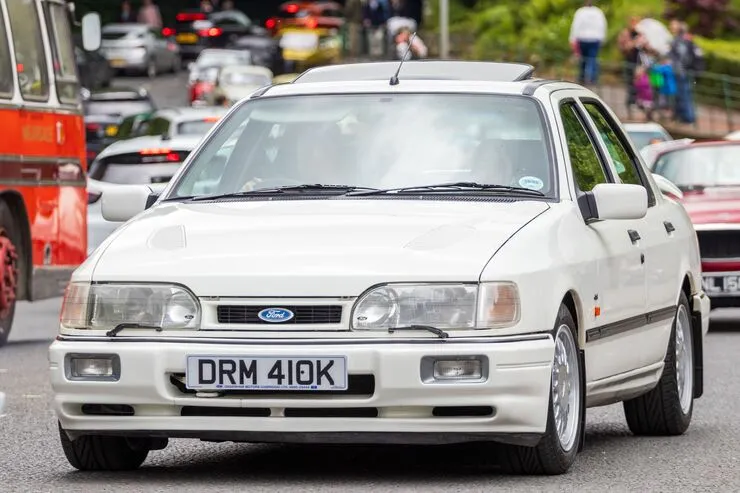
In 1986, Ford introduced one of the most famous fast Fords ever built: the Sierra RS Cosworth.
Developed partly to give Ford a competitive car for touring-car racing, it combined the practical Sierra hatchback body with a turbocharged 2.0-litre Cosworth engine producing around 204 bhp in road-going form.
Visually, there was little chance of mistaking it for an ordinary Sierra. Its huge rear wing, deeper spoilers and distinctive bodywork gave the RS Cosworth an aggressive appearance that became synonymous with the performance cars of the 1980s.
Ford followed it with the limited-production Sierra RS500 Cosworth in 1987. Just 500 examples were converted, with changes designed to improve the car’s potential in competition. In racing form, the RS500 became enormously successful in touring-car championships around the world.
Later Sierra Cosworth models adopted a more discreet four-door saloon body, and four-wheel drive was eventually introduced, demonstrating how quickly Ford’s high-performance technology was developing.
The Sierra RS Cosworth helped transform the RS badge for a new generation. It combined motorsport credibility, turbocharged performance and an everyday Ford platform — a formula Ford would revisit with later RS models.Mustangs ever built, featuring a naturally aspirated 5.4-litre V8 producing 385bhp.
Escort RS Cosworth: The Rally-Bred Icon
The Escort RS Cosworth arrived in the early 1990s and became another defining Ford RS model. Despite its Escort appearance, underneath it shared important mechanical architecture with the Sierra Cosworth and was created with international rallying firmly in mind.
Its most recognisable feature was the enormous “whale-tail” rear spoiler, but the engineering underneath was just as significant. The Escort RS Cosworth combined a turbocharged 2.0-litre Cosworth engine with permanent four-wheel drive, giving it performance far beyond that of an ordinary Escort.
Early road cars produced around 227 bhp, with later versions receiving a smaller, more responsive turbocharger to improve everyday drivability.
Ford produced the car in sufficient numbers to satisfy motorsport homologation requirements, and the Escort RS Cosworth went on to compete successfully at the highest levels of international rallying.
Today, its combination of dramatic styling, motorsport heritage and relative rarity has made the Escort RS Cosworth one of the most recognisable and desirable fast Fords of its era. heritage styling with modern engineering.
One example of just how collectible these cars have become is this low-mileage Escort RS Cosworth that sold for more than £200,000.
Ford Focus RS: The RS Badge Enters the Modern Era
After the Escort RS Cosworth, Ford eventually brought the RS badge back with a very different kind of performance car: the Focus RS.
Launched in 2002, the first-generation Focus RS used a turbocharged 2.0-litre engine producing around 212 bhp. Unlike the four-wheel-drive Escort RS Cosworth, power went through the front wheels, with a limited-slip differential helping the car put its performance onto the road.
Production was limited, making the original Focus RS a relatively rare model and establishing it as the starting point for a new generation of fast Fords.
The second Focus RS arrived in 2009 and raised the stakes considerably. Its turbocharged 2.5-litre five-cylinder engine produced around 300 bhp, yet Ford again chose front-wheel drive. Sophisticated suspension and differential technology helped manage the considerable power.
Ford pushed the concept even further with the Focus RS500, a limited edition producing around 345 bhp, with just 500 examples built.
Then, in 2016, the third-generation Focus RS changed the formula again. Its turbocharged 2.3-litre EcoBoost engine produced around 350 PS, while a sophisticated four-wheel-drive system could distribute torque between the rear wheels. It even introduced a dedicated Drift Mode.
Across three generations, the Focus RS demonstrated how the meaning of RS had evolved. The cars were increasingly sophisticated and usable every day, but Ford continued to give them the performance and distinctive character expected from the Rallye Sport badge.
The Focus RS also features in our look at future classic cars that could become increasingly desirable.
What Happened to Ford RS?
The third-generation Focus RS ended production in 2018, and Ford has not launched another RS production model since.
That doesn’t mean Ford abandoned performance cars altogether. The company continued with its ST models, including the Focus ST and Puma ST, while the Mustang remained an important part of Ford’s performance range.
But creating another RS has become more difficult. Modern emissions regulations, electrification and the cost of developing specialist high-performance models have changed the environment in which cars such as the Focus RS were created.
Ford has continued to use its motorsport experience to develop performance vehicles, but whether the RS badge itself will return to a production road car remains uncertain.
For enthusiasts, that uncertainty has arguably made previous RS models even more interesting. From homologation specials such as the RS200 and Escort RS Cosworth to the three generations of Focus RS, they represent very different periods in Ford’s performance-car history.
Which Ford RS Was the Fastest?
Comparing Ford RS models isn’t quite as straightforward as simply looking at top speed. The cars were built in different eras and for very different purposes, from rally homologation specials to modern high-performance hatchbacks.
Among the regular road-going production models, the third-generation Focus RS was one of the most powerful, with around 350 PS from its 2.3-litre EcoBoost engine and a claimed top speed of approximately 165 mph.
The Focus RS500 was also exceptionally powerful for its time, producing around 350 PS from its 2.5-litre five-cylinder engine, while the Sierra and Escort RS Cosworth models delivered their performance with considerably less power but strong links to competition.
The RS200 is harder to compare directly. Road versions were relatively restrained compared with the increasingly powerful competition and Evolution versions developed for motorsport.
Ultimately, outright speed tells only part of the RS story. What connects these cars is Ford’s willingness to take performance engineering developed around motorsport and apply it to memorable road cars.
Why Ford RS Still Matters
Few performance badges have covered such a varied collection of cars as Ford RS. Over more than five decades, the name has appeared on lightweight Escorts, rally homologation specials, turbocharged Cosworths and some of the most powerful hot hatchbacks Ford has produced.
The technology changed dramatically along the way, but the basic idea remained remarkably consistent: take Ford’s motorsport experience and use it to create something more exciting for the road.
Cars such as the Escort RS1600, RS200, Sierra RS Cosworth, Escort RS Cosworth and Focus RS each represent a different chapter in that story. Some are now highly collectable, while others remain relatively accessible ways to own a significant piece of fast-Ford history.
Even though there is currently no new Ford RS model in production, the badge remains an important part of Ford’s performance heritage — and one that enthusiasts are unlikely to forget.
Thinking About Selling Your Current Car?
Whether you own a performance Ford or something completely different, knowing its current value is a useful place to start. Use jamjar’s free car valuation tool to find out what your car could be worth today.