
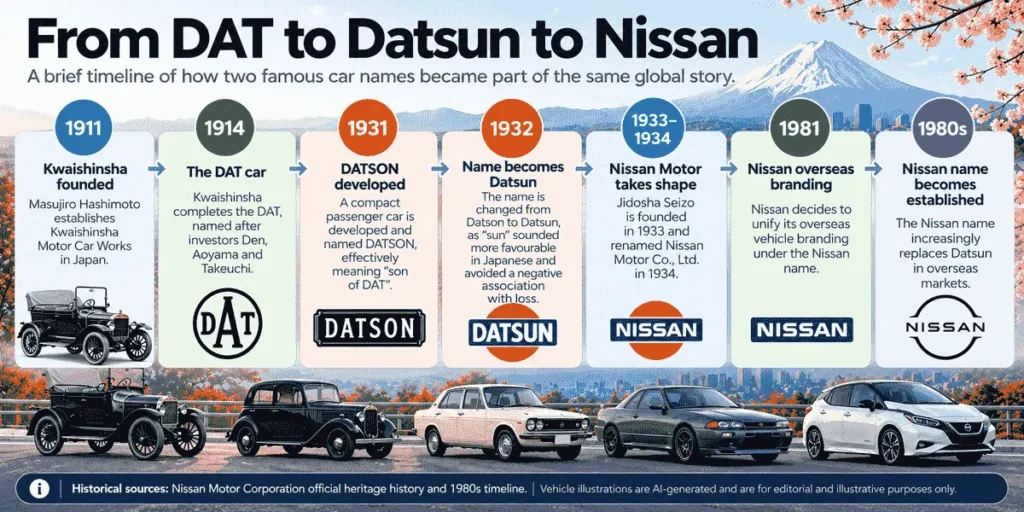
The story of Datsun and Nissan stretches back more than a century and involves several companies, name changes and some of Japan’s earliest attempts to build cars domestically. The famous Datsun name grew from the DAT car of 1914, while Nissan Motor itself was established in the 1930s. The two names would eventually become part of the same global automotive story.
For more advice on vehicle pricing, depreciation and market trends, visit our valuation guidance hub.
Where It All Began
The roots of the Datsun name go back to the Kwaishinsha Motor Car Works, founded in Japan by Masujiro Hashimoto in 1911.
In 1914, the company completed a small passenger car called the DAT. Its name came from the surnames of three of Kwaishinsha’s investors: Den, Aoyama and Takeuchi.
After a series of company changes and mergers, DAT Jidosha Seizo developed a smaller passenger car in 1931. It was initially called DATSON — effectively meaning “son of DAT”. However, because “son” sounded like a Japanese word associated with loss or disadvantage, the name was changed to Datsun, with “sun” providing a more positive association.
The Datsun name was born, but Nissan Motor had not yet been created. That would follow during the rapid development of Japan’s motor industry in the early 1930s.
How Was Nissan Created?
The Nissan name developed separately from the original DAT story. Businessman Yoshisuke Aikawa established the holding company Nihon Sangyo, whose name was commonly shortened to “Ni-San” on the Tokyo Stock Exchange.
In December 1933, Aikawa established Jidosha Seizo Co., Ltd. to manufacture automobiles. The following year, the company became Nissan Motor Co., Ltd.
Datsun became the name used on many of the company’s passenger cars, while Nissan was the corporate name behind them. This distinction helps explain why drivers around the world became familiar with Datsun cars long before the Nissan badge became dominant internationally.
During the decades that followed, Datsun vehicles were exported to a growing number of markets, helping Nissan establish an international reputation for affordable, practical and increasingly desirable Japanese cars.
The Transition from Datsun to Nissan
By the early 1980s, Nissan was selling vehicles internationally under both the Nissan and Datsun names. The company decided that using one global brand would create a clearer and more consistent identity.
In 1981, Nissan announced that the Datsun name would gradually be phased out in favour of Nissan. The change did not happen overnight. During the transition, some vehicles and marketing carried both names as customers became accustomed to the Nissan brand.
By the mid-1980s, the Datsun name had largely disappeared from new cars in major export markets and Nissan had become the company’s principal global vehicle brand.
The change was a major undertaking. Decades of recognition had been built around Datsun, so dealerships, advertising, signage and marketing materials all had to be updated while Nissan established its own identity with existing customers.
Although Datsun disappeared from most showrooms, the name retained a strong following among enthusiasts — particularly because of cars such as the Datsun 240Z and 510.
The history of famous car names often contains some surprising connections. Another great example is the connection between the Porsche 911 and Volkswagen Beetle, which traces the shared engineering roots behind two very different automotive icons.
Nissan’s Most Influential Models
Over the decades, Datsun and Nissan produced several models that helped establish the company’s reputation around the world. Some became important family cars, while others created performance-car names that Nissan still uses today.
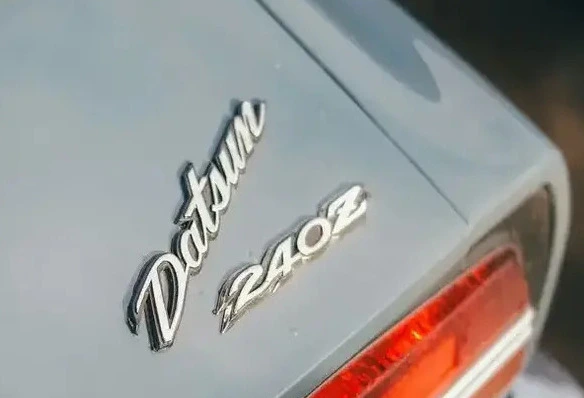
Datsun 240Z
Launched in Japan in 1969 as the Fairlady Z and sold in export markets including the United States as the Datsun 240Z, the Z helped establish Datsun as a serious sports-car manufacturer. Its combination of distinctive styling, six-cylinder performance and comparatively accessible pricing made it one of the defining Japanese sports cars of its era.
The Z name survived the transition from Datsun to Nissan and continues to form an important part of the company’s performance-car history.
Nissan Skyline
The Skyline name actually predates Nissan’s ownership of the model. It began with Prince Motor Company in the 1950s before becoming part of Nissan when the two companies merged in 1966. Over subsequent generations, the Skyline developed from a family and executive car into one of Nissan’s most famous performance-car names.
The high-performance Skyline GT-R models became particularly celebrated, combining powerful engines with increasingly sophisticated technology and achieving considerable success in motorsport. Today, classic Skyline GT-Rs are among the most recognisable Japanese performance cars of their era.
The Skyline has a fascinating history of its own, from its beginnings with Prince Motor Company to the famous GT-R generations. You can explore that story in our history of the Nissan Skyline.
Nissan Leaf
Launched in 2010, the Nissan Leaf became one of the first mass-market modern electric cars and played an important role in bringing battery-electric motoring to mainstream buyers. It offered drivers a practical five-door electric car at a time when EVs were still a relatively unusual sight on the road.
The Leaf went on to become one of the world’s best-known electric cars and marked another significant chapter in Nissan’s history — very different from the Datsun sports cars and family models on which much of its earlier international reputation had been built.
Nissan Today
Today, Nissan remains a major global car manufacturer, producing everything from small cars and SUVs to commercial vehicles and electric models. The company continues to develop electrified vehicles while also building on long-established names such as the Qashqai, X-Trail and the Z sports-car family.
The automotive industry is changing rapidly, particularly as manufacturers invest in electric and hybrid technology. Nissan’s history shows that reinvention is nothing new for the company: it has evolved through different businesses, brands and technologies for more than a century.
The Datsun name itself has also had an unusual afterlife. Nissan revived Datsun in 2013 for selected emerging markets, before later discontinuing the revived brand. For enthusiasts, however, Datsun remains closely associated with some of the Japanese cars that first established Nissan’s international reputation.
Understanding the Value of Your Vehicle
Whether you own a classic Datsun, a modern Nissan, or any other vehicle, understanding its current market value is an important part of ownership.
You can use our car valuation service to get an estimate of what your vehicle could be worth today.