
Tesla’s 4680 battery was unveiled in 2020 as a major part of the company’s plan to make electric vehicles cheaper to manufacture, increase driving range and dramatically expand battery production.
The larger cylindrical cell was designed to work alongside changes in battery chemistry, manufacturing and vehicle construction. Tesla’s ambition was not simply to produce a different-sized battery cell, but to rethink how batteries could be manufactured and integrated into an electric car.
Several years later, the 4680 is no longer simply a future concept. Tesla has put the technology into production and continued developing its manufacturing processes, although reaching the scale and cost reductions originally envisaged has proved more complicated than the initial announcement suggested.
That makes the 4680 story particularly interesting today. Rather than asking what Tesla’s new battery technology might do, we can now look at what the company originally promised, how the technology has developed and what it could still mean for the future of electric cars.
Battery technology, range, charging capability and changing demand can all influence how electric cars hold their value over time. Our Valuation Guidance hub explains the different factors that can affect what a car is worth.
A Major Step Forward in Battery Development
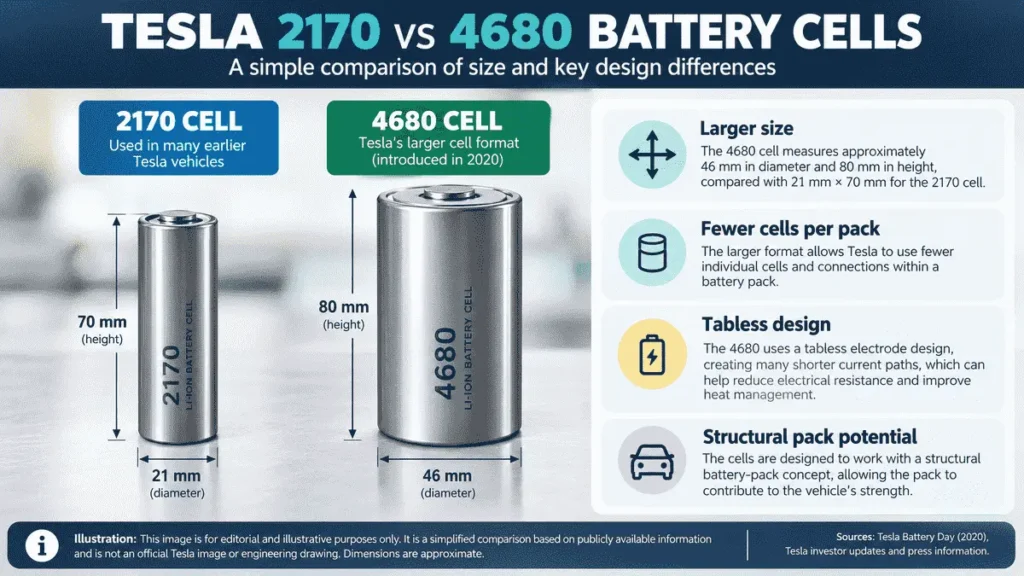
Tesla unveiled the 4680 cell at its Battery Day event in September 2020. The name comes from the cell’s dimensions: approximately 46mm in diameter and 80mm tall, making it considerably larger than the cylindrical cells traditionally used in many Tesla vehicles.
But increasing the size of the cell was only one part of the plan. Tesla outlined a series of changes covering cell design, electrode manufacturing, battery materials and the way the battery pack could become part of the vehicle’s structure.
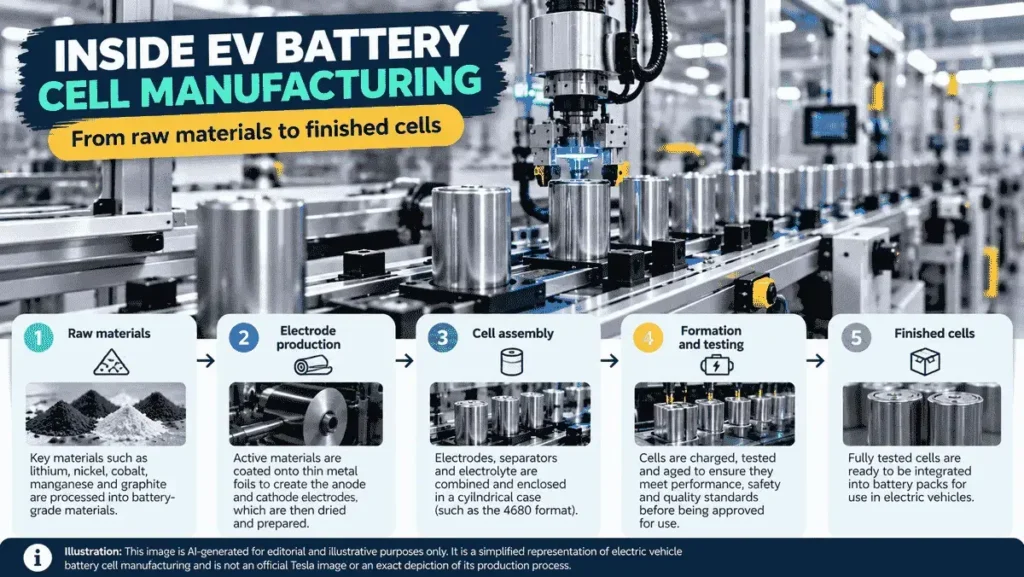
One of the most significant ideas was a dry-electrode manufacturing process. Conventional battery production uses energy-intensive coating and drying stages, whereas Tesla’s proposed process was intended to simplify production, reduce factory energy consumption and ultimately help lower the cost of manufacturing battery cells.
Tesla also proposed integrating 4680 cells into a structural battery pack, allowing the pack itself to contribute to the strength of the vehicle rather than simply being carried within it. Together, these changes were intended to improve manufacturing efficiency, reduce weight and help Tesla produce electric vehicles at greater scale.
And if you’re curious about how Tesla could use advances like these in smaller, more affordable models, our look at the Tesla hatchback explores what a compact Tesla could bring to the market.
From Battery Day Promise to Real-World Production
At Battery Day, Tesla presented the 4680 programme as a route towards substantially cheaper batteries, greater manufacturing scale and more affordable electric vehicles. The targets were ambitious, and turning those ideas into mass-production processes proved more difficult and time-consuming than simply developing the cell itself.
Since then, however, the 4680 has moved beyond prototype status. Tesla has manufactured the cells in the United States, used 4680 battery packs in production vehicles and continued developing the dry-electrode manufacturing processes that formed an important part of the original plan.
By 2026, the important question is therefore no longer whether Tesla can manufacture a 4680 cell. It is whether the company can produce the technology efficiently, consistently and at sufficient scale for the original cost and manufacturing advantages to become significant across more of its vehicle range.
Global Manufacturing Expansion
Battery manufacturing has become an increasingly important part of Tesla’s wider production strategy. Rather than relying entirely on external cell suppliers, the company has invested in developing and manufacturing its own 4680 cells alongside batteries supplied by established manufacturers.
Tesla has concentrated much of its 4680 development and production in Texas, where the company has continued working on both cell manufacturing and the dry-electrode processes originally outlined at Battery Day.
This matters because the long-term success of the 4680 programme depends on more than the performance of an individual battery cell. Tesla needs to manufacture enormous numbers of cells reliably and at a competitive cost if the technology is to deliver the scale advantages originally promised.
The challenge facing Tesla — and the wider EV industry — is therefore increasingly about manufacturing. Better battery chemistry is important, but producing batteries faster, using less energy and fewer manufacturing steps, while maintaining quality and safety, could be just as significant for reducing the cost of electric vehicles.
The New 4680 Battery Cell
The 4680 is a larger cylindrical lithium-ion battery cell, measuring approximately 46mm in diameter and 80mm in height. Its size allows Tesla to use fewer individual cells and electrical connections within a battery pack compared with a pack built from smaller cylindrical cells.
An important part of the original design was Tesla’s tabless electrode architecture. Instead of relying on conventional tabs to carry electrical current from the electrodes, the design creates many shorter current paths. Tesla presented this as a way to reduce electrical resistance and improve the cell’s ability to manage power and heat.
The 4680 was also designed to work with Tesla’s structural battery-pack concept. In vehicles using this approach, the battery pack contributes to the structure of the vehicle itself rather than simply sitting inside a separate supporting structure.
Importantly, however, the 4680 should not be viewed as one breakthrough that automatically delivers longer range, faster charging and cheaper electric cars. Its potential advantages depend on the chemistry used inside the cell, pack design and — crucially — whether Tesla can manufacture the cells efficiently and at very large scale.
Material Improvements and Chemistry Changes
Battery performance isn’t determined by cell size alone. The materials used in the cathode and anode have a major influence on factors including energy density, cost, durability and how a battery performs over its lifetime.
At Battery Day, Tesla outlined plans to reduce its reliance on expensive battery materials, develop different cathode chemistries for different vehicle applications and increase the use of silicon in battery anodes. Silicon has the potential to store more lithium than conventional graphite, but managing its expansion and degradation during repeated charging cycles presents significant engineering challenges.
Tesla’s wider strategy has therefore involved improving several parts of battery production simultaneously rather than relying on one new chemistry. Cell design, electrode materials, manufacturing processes and structural integration all contribute to the eventual performance and cost of a battery pack.
This is an important distinction when considering the 4680. Two batteries using the same 4680 cell format do not necessarily have identical chemistry or performance characteristics, and the technology can continue to evolve without changing the basic dimensions of the cell.
Tesla’s Broader Energy Ambitions
Tesla’s battery ambitions extend beyond electric cars. The company also manufactures large-scale energy-storage products designed to store electricity for homes, businesses and electricity grids.
Although Tesla’s stationary energy-storage products don’t necessarily use the same cells or chemistry as its vehicles, the businesses are connected by a common challenge: producing enormous quantities of batteries efficiently and at increasingly competitive costs.
Improvements in battery manufacturing can therefore have implications beyond vehicle range or performance. Greater production capacity and lower battery costs could support both electric transport and the storage needed to make greater use of intermittent renewable electricity such as solar and wind power.
And for a glimpse at how far Tesla’s performance ambitions might go with improved battery tech, our deep dive into the Tesla Roadster explores the innovations that could shape its future capabilities.
What This Means for Drivers
For drivers, the significance of the 4680 isn’t really the size or shape of the battery cell. What matters is whether technologies like this eventually make electric cars more affordable, practical and economical to own.
If Tesla can manufacture 4680 cells more efficiently and at greater scale, the potential benefits could include lower battery-production costs, improved vehicle efficiency and greater flexibility in how future electric cars are designed. Battery manufacturing improvements could also help reduce one of the largest costs involved in producing an EV.
However, drivers shouldn’t assume that every vehicle fitted with 4680 cells will automatically offer greater range or faster charging than a vehicle using a different battery format. Range, charging performance and battery longevity depend on the complete battery pack, its chemistry, thermal management, vehicle efficiency and software as well as the individual cells.
The bigger story is therefore what the 4680 represents: the automotive industry’s continuing attempt to make batteries cheaper and easier to manufacture at enormous scale. If those improvements continue, they could help make electric vehicles accessible to a wider range of motorists.
Key Takeaway
Tesla’s 4680 battery is best understood as part of a much bigger attempt to change how electric-vehicle batteries are designed and manufactured. The larger cell attracted much of the attention when it was announced, but dry-electrode production, structural battery packs, new materials and manufacturing scale are equally important parts of the story.
The journey from Tesla’s 2020 Battery Day presentation to real-world production has also demonstrated how difficult it is to turn promising battery technology into something that can be manufactured reliably and economically in enormous volumes.
The 4680 story isn’t finished. If Tesla can continue improving production efficiency and reducing costs, the technology could still play an important role in making future electric vehicles cheaper and easier to manufacture. Its ultimate significance will depend less on the dimensions of the cell itself and more on whether the complete manufacturing system delivers the advantages Tesla originally set out to achieve.
If developments in electric-car technology have you thinking about changing your current vehicle, our free car valuation tool can give you an estimate of what your car could be worth today.