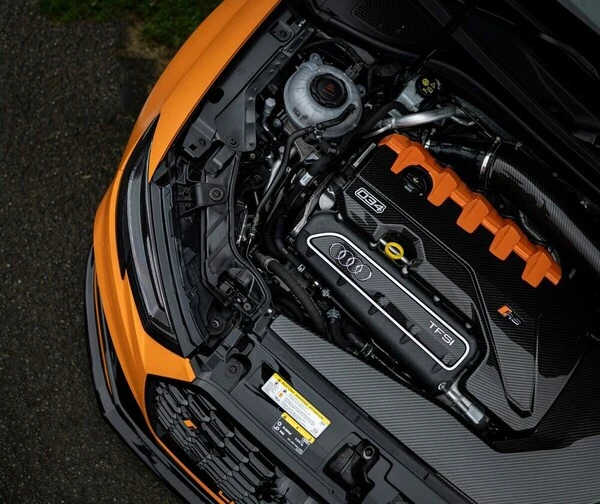
If you’ve looked at almost any modern Audi, you’ve probably seen the letters TFSI after the model name. They identify the type of petrol engine the car uses — but what does TFSI actually mean?
TFSI stands for Turbo Fuel Stratified Injection, Audi’s name for petrol engines that combine turbocharging with direct fuel injection. The technology is designed to provide strong performance while improving fuel efficiency compared with older, naturally aspirated petrol engines.
You’ll find TFSI engines across much of Audi’s range, from smaller models such as the A1 and A3 to larger saloons and SUVs. You may also see numbers such as 30 TFSI, 35 TFSI or 40 TFSI. These numbers relate to the car’s approximate power output rather than its engine capacity — something we’ll explain below.
TFSI shouldn’t be confused with TDI, which Audi uses for diesel engines, or TFSI e, which identifies certain plug-in hybrid models.
In this guide, we’ll explain how TFSI works, what Audi’s TFSI numbers mean, how it compares with TSI and FSI engines, and what to consider if you’re buying a used Audi with a TFSI engine.
For more help understanding different cars, specifications and what can affect their value, visit our valuation guidance hub.
TFSI engines explained
A TFSI engine combines two important petrol-engine technologies: turbocharging and direct fuel injection.
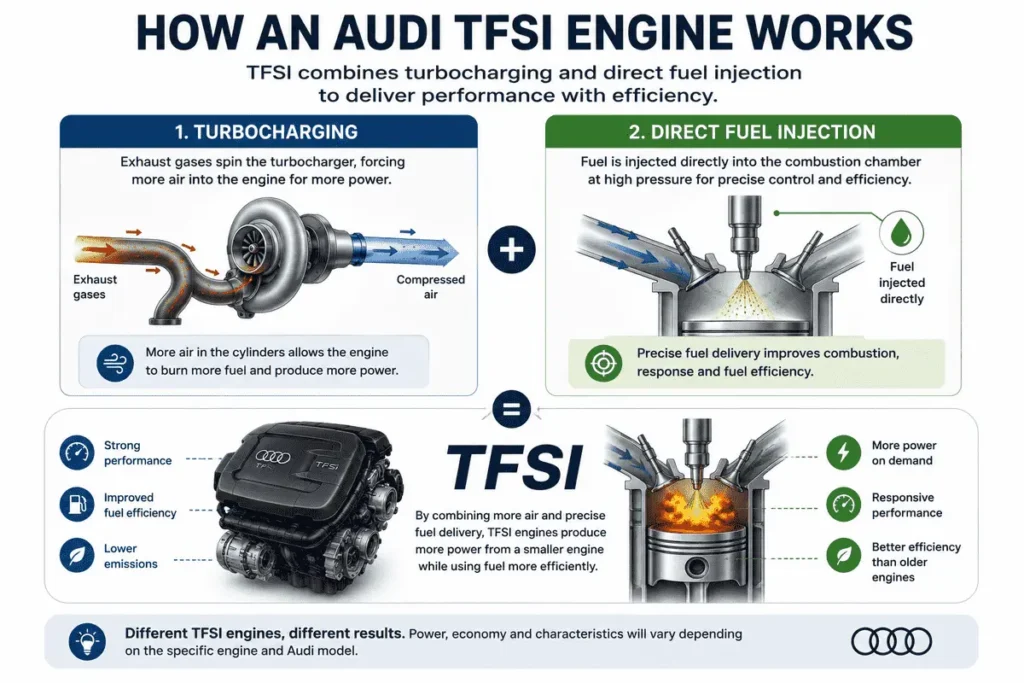
The turbocharger uses exhaust gases to force more air into the engine, allowing it to produce more power without simply relying on a larger engine. Direct injection delivers fuel directly into the combustion chamber, giving the engine more precise control over how fuel is used.
Together, these technologies allow Audi to produce relatively compact petrol engines that can deliver strong performance while also improving fuel efficiency. The exact power, economy and characteristics will naturally vary depending on the particular TFSI engine and Audi model.
TFSI is closely related to other Volkswagen Group petrol-engine terminology, particularly TSI and the earlier FSI engines. The basic differences are shown below.
What does TFSI e mean?
TFSI e is Audi’s name for its plug-in hybrid (PHEV) models. These cars combine a TFSI petrol engine with an electric motor and a rechargeable battery, allowing them to drive for a certain distance using electric power alone.
Unlike a standard hybrid, a TFSI e can be plugged in to recharge its battery. For shorter journeys, this can allow drivers to use electric power more frequently, while the petrol engine remains available for longer trips or when additional performance is needed.
The electric-only range, performance and fuel economy vary considerably between different Audi TFSI e models, so it’s worth checking the specifications of the particular car you’re considering.