
If you’ve spent any time looking at performance cars, you’ve almost certainly come across the Mercedes-AMG badge.
Mercedes-AMG is the high-performance division of Mercedes-Benz, responsible for developing some of the brand’s fastest and most powerful road cars. AMG models aren’t simply standard Mercedes cars with sportier styling — they can feature specially developed engines, upgraded suspension, stronger brakes and extensive performance engineering.
The AMG name comes from founders Hans Werner Aufrecht and Erhard Melcher, together with Großaspach, Aufrecht’s birthplace. What began as an independent engineering company in 1967 eventually became an integral part of Mercedes-Benz.
Today, the AMG badge appears on everything from performance hatchbacks and saloons to SUVs and dedicated sports cars. However, there is an important difference between a Mercedes-AMG and a Mercedes wearing an AMG Line trim package.
In this guide, we’ll explain what AMG means, how genuine Mercedes-AMG cars differ from standard Mercedes-Benz models and AMG Line cars, and what buyers should know about the performance brand.
Let’s take a closer look.
For more manufacturer and performance car guides, visit our valuation guidance hub.
What Does AMG Stand For?
AMG takes its name from its founders:
- Aufrecht (Hans Werner Aufrecht)
- Melcher (Erhard Melcher)
- Grossaspach (Aufrecht’s birthplace)
AMG was founded in 1967 by Hans Werner Aufrecht and Erhard Melcher as an independent engineering company specialising in racing engines and performance modifications for Mercedes-Benz vehicles.
Its reputation grew through motorsport and increasingly powerful road-car conversions. Mercedes-Benz gradually developed a closer relationship with AMG, before taking a controlling interest in the company in 1999. AMG ultimately became wholly owned by Daimler in 2005.
Today, Mercedes-AMG operates as the performance division of Mercedes-Benz, developing vehicles that go considerably further than cosmetic upgrades.
What Makes a Mercedes-AMG Different?
At first glance, many Mercedes-AMG models look similar to their standard Mercedes-Benz counterparts.
The real differences lie beneath the surface.
Mercedes-AMG vehicles typically feature:
- More powerful engines
- Performance-tuned suspension
- Upgraded braking systems
- Enhanced steering systems
- Sportier exhaust systems
- Aggressive body styling
- Unique interior finishes
The result is a car designed to deliver sharper handling, faster acceleration and a more engaging driving experience.
The History of Mercedes-AMG
AMG built its reputation through motorsport during the 1970s and 1980s.
One of the company’s most famous early creations was the legendary Mercedes-Benz 300 SEL 6.8 AMG, nicknamed the “Red Pig”, which shocked the motorsport world with its performance.
Another iconic AMG model was the AMG Hammer, based on the Mercedes-Benz E-Class. During the late 1980s, it became one of the fastest saloon cars in the world thanks to its powerful V8 engine.
A major milestone came in 1993 when Mercedes-Benz and AMG launched the first jointly developed production vehicle, helping establish AMG as a global performance brand.
Today, Mercedes-AMG produces some of the most exciting performance vehicles on the road.
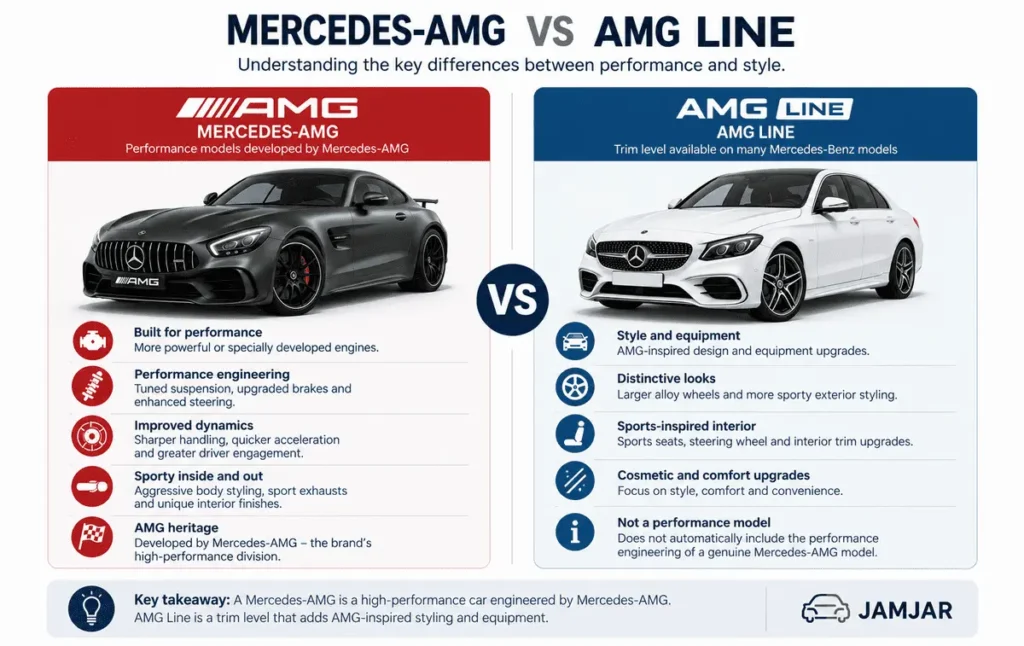
How Are AMG Models Different From AMG Line Models?
This is one of the most important distinctions for buyers to understand. Mercedes-AMG and AMG Line are not the same thing.
A genuine Mercedes-AMG is a performance model developed by Mercedes-AMG. Depending on the model, this can mean a more powerful or specially developed powertrain, performance suspension, upgraded brakes, revised steering, additional cooling and significant changes to the way the car drives.
Examples include cars such as the Mercedes-AMG A 45, C 63, G 63 and AMG GT.
AMG Line, by contrast, is primarily a trim level available on many regular Mercedes-Benz models. It gives the car some of the visual character associated with AMG without necessarily receiving the full performance engineering of a genuine Mercedes-AMG model.
If you’re unsure what the badge includes, our guide to what Mercedes AMG Line means explains the trim level in more detail.
AMG Line equipment can include:
- AMG-inspired body styling
- larger alloy wheels
- sports seats and steering wheel
- revised interior trim
- other cosmetic or equipment upgrades
So, if you’re looking at a used Mercedes advertised as “AMG”, check the exact model designation rather than relying on the appearance or AMG badges alone. An AMG Line Mercedes is not automatically a Mercedes-AMG performance car.
This distinction can also matter when comparing used-car prices, running costs, insurance and performance.
Which Mercedes-Benz Models Are Available as AMG Variants?
The Mercedes-AMG range changes over time, but AMG performance models have been offered across many parts of the Mercedes-Benz line-up, from compact cars and saloons to SUVs and dedicated sports cars.
Popular examples include:
Mercedes-AMG A-Class
A high-performance hot hatch offering impressive acceleration and everyday usability.
Mercedes-AMG C-Class
One of AMG’s most recognisable performance saloons.
Mercedes-AMG E-Class
Combining luxury and serious performance.
Mercedes-AMG GLC and GLE
Performance SUVs that deliver sports car levels of pace with everyday practicality.
Mercedes-AMG GT
A dedicated sports car developed by AMG that showcases the division’s engineering expertise.
Hand-Built AMG Engines
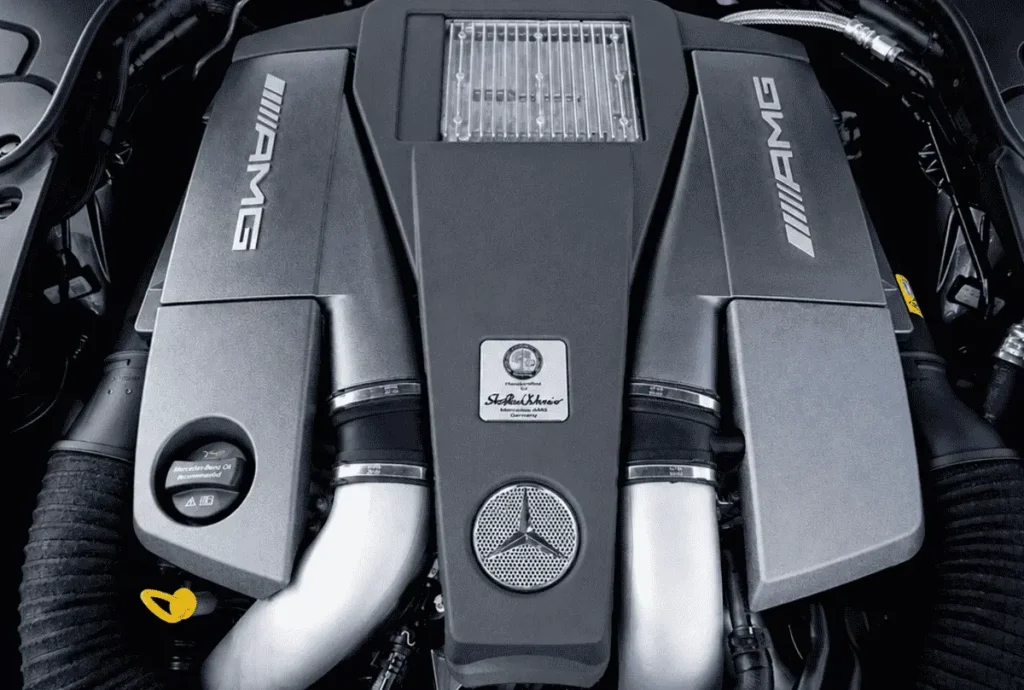
One of the most famous aspects of Mercedes-AMG is its “One Man, One Engine” philosophy.
Many Mercedes-AMG engines are traditionally assembled by a single technician, who signs a plaque attached to the finished engine.
This tradition reflects AMG’s focus on craftsmanship and attention to detail.
While some modern AMG models use smaller turbocharged engines and hybrid assistance, the division remains committed to delivering exceptional performance.
Driving Performance
Mercedes-AMG vehicles are designed to be exciting from behind the wheel.
Depending on the model, drivers can expect:
- Rapid acceleration
- Enhanced handling
- Performance-tuned suspension
- Powerful braking systems
- Intelligent four-wheel drive systems
- Distinctive exhaust notes
Many modern AMG models can accelerate from 0-62mph in under four seconds, placing them among the quickest performance cars available today.
Is Mercedes-AMG Worth It?
If you’re looking for a vehicle that combines luxury, technology and serious performance, a Mercedes-AMG could be the perfect choice.
While they typically cost more than standard Mercedes-Benz models, buyers benefit from:
- Increased performance
- Exclusive styling
- Enhanced driving dynamics
- Greater exclusivity
- Motorsport-inspired engineering
For enthusiasts, the AMG badge remains one of the most desirable names in the automotive world.
If you’re comparing performance-inspired badges between manufacturers, you can also find out what BMW M Sport means and how it differs from BMW’s full M performance cars.
Thinking About Changing Your Car?
Whether you’re moving into a performance car or simply looking for something new, Jamjar can help.
Compare offers from a trusted network of UK car buyers and get a competitive valuation for your current vehicle without the hassle of negotiating.