
Vehicle recalls are an important part of keeping cars safe. Manufacturers issue recalls when a defect is identified that could affect vehicle safety or mean that a vehicle no longer meets the required legal standard.
For an individual owner, a recall will usually mean taking the car to an authorised repairer so the necessary work can be completed, normally without charge.
But recalls can also have significant consequences in the used-car market. Dealers and car supermarkets have responsibilities when supplying vehicles with known safety defects, and an outstanding safety recall may need to be resolved before a vehicle can be supplied to its next owner.
That can become particularly complicated when a recall has been announced but the manufacturer does not yet have the parts or repair procedure available to complete the work.
In this guide, we’ll explain how vehicle recalls work, how to check whether your car is affected, what they mean when buying or selling a used vehicle, and what happens when a recall repair isn’t immediately available.
For more practical advice on looking after your vehicle, visit our car maintenance guidance.
What Is a Vehicle Recall?
A vehicle safety recall is action taken when a manufacturer identifies a safety-related defect affecting vehicles that have already been supplied to customers.
The Driver and Vehicle Standards Agency (DVSA) oversees vehicle safety recalls in the UK. A serious safety defect is generally one arising from the design or manufacture of the vehicle that could create a significant risk of injury if it is not corrected.
When a vehicle is recalled, affected owners are normally contacted and asked to arrange an inspection or repair through the manufacturer’s dealer or authorised repair network. Safety-recall work is usually carried out without charge.
Recalls can cover a wide range of issues, including:
- Faulty airbags
- Braking systems
- Steering components
- Fuel system defects
- Electrical faults
- Windscreen wiper failures
- Fire risks
The severity of recalls varies, but all safety recalls should be taken seriously.
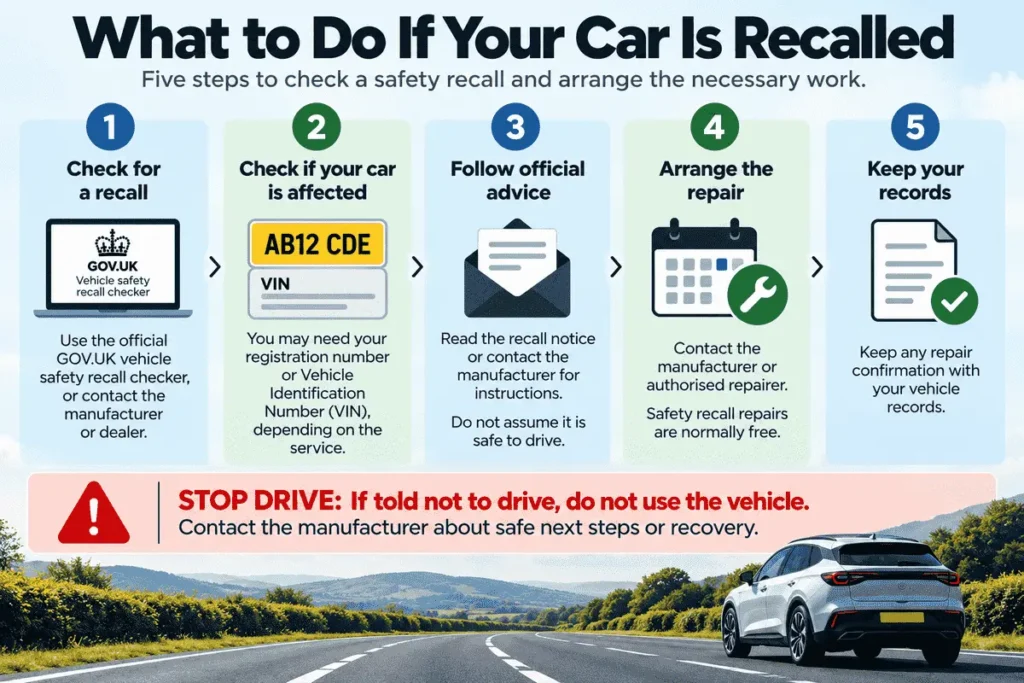
How Do You Find Out If Your Car Has Been Recalled?
In most cases, your vehicle manufacturer will contact you directly using the registered keeper details held by the DVLA.
However, if you’ve recently purchased a used car or are unsure whether previous recall work has been completed, it’s worth checking yourself.
You can:
- Contact your vehicle manufacturer.
- Ask your local franchised dealer.
- Use the official GOV.UK vehicle recall checker.
- Provide your Vehicle Identification Number (VIN) or registration number when requested.
Checking before purchasing a used vehicle can also provide extra peace of mind.
Why Are Cars Recalled?
Manufacturers issue recalls whenever a fault could create a safety risk for drivers, passengers or other road users.
Common reasons include:
- Brake defects
- Fuel leaks
- Airbag faults
- Steering issues
- Seat belt failures
- Electrical problems
- Fire risks
Once a potential defect has been identified, engineers investigate the issue before determining whether a formal recall is required.
What Does a Safety Recall Mean for a Used Car Dealer?
Safety recalls can create a particular problem for used-car retailers.
Under UK product-safety rules, businesses supplying products to consumers have a responsibility not to supply something they know — or should know — is dangerous. DVSA guidance specifically applies this principle to the used-vehicle industry and says that vehicles with outstanding safety recalls should not be passed to consumers until the necessary recall work has been completed.
This applies not only to franchised dealerships but also to independent used-car retailers and car supermarkets.
In practice, responsible retailers should check vehicles for outstanding safety recalls and arrange for any required work to be completed before supplying the car to a customer.
Usually this is relatively straightforward: the vehicle is booked into the manufacturer’s authorised repair network, the recall work is completed and the car can then be supplied.
The difficult situation arises when a manufacturer has announced a safety recall but a repair, replacement part or technical remedy is not yet available. A retailer may then have a perfectly usable-looking vehicle sitting in stock that cannot simply be handed over to a customer until the safety issue can be resolved.
For large used-car retailers holding significant numbers of vehicles, recalls can therefore create considerable operational problems as well as inconvenience for individual motorists.

What If There Is No Recall Fix Available Yet?
Sometimes a manufacturer identifies a safety problem before a permanent repair is ready.
In these circumstances, owners and retailers may have to wait for further instructions, replacement parts or an approved repair procedure from the manufacturer.
The advice can vary according to the seriousness of the defect. Some vehicles may remain safe to use while awaiting repair, while a serious safety defect can result in instructions not to drive the vehicle at all.
If your vehicle is affected, follow the manufacturer’s instructions rather than assuming that it is safe to continue driving. If you’re considering buying an affected used car, ask whether the recall work has been completed and request evidence if necessary.
Are There Different Types of Recall?
Yes.
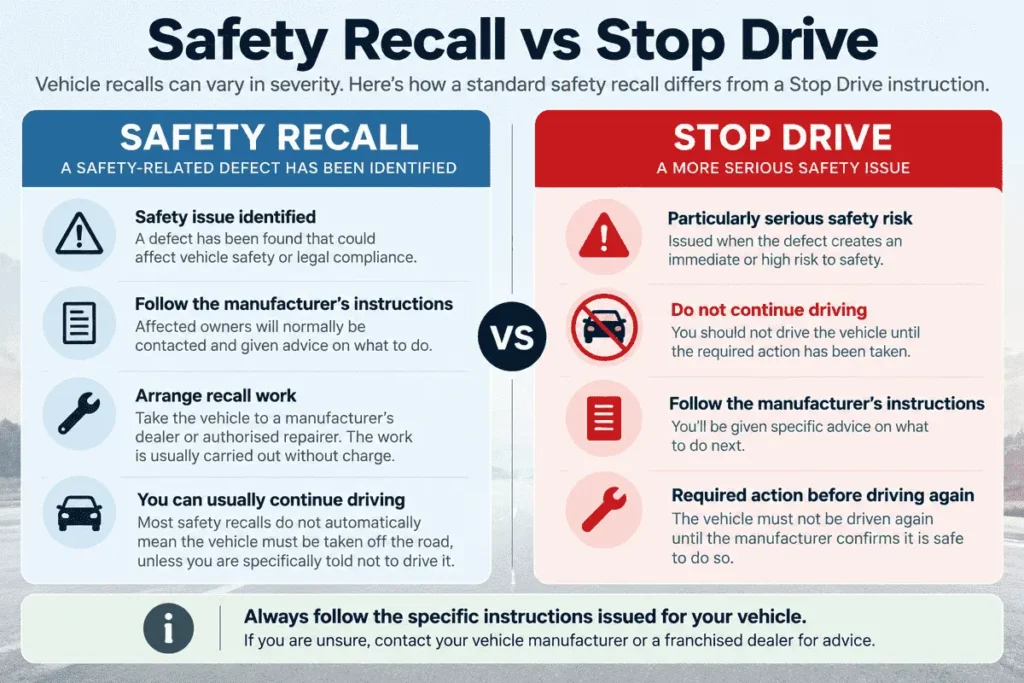
Stop Drive Recall
A Stop Drive instruction is reserved for particularly serious situations where continuing to use the affected vehicle could present an immediate safety risk.
If your vehicle is subject to a Stop Drive instruction, follow the manufacturer’s advice and do not continue driving it until the required action has been taken.
Safety Recall
Most safety recalls do not necessarily mean that a vehicle must immediately stop being driven.
Owners should follow the manufacturer’s instructions and arrange for the recall work to be completed as soon as reasonably possible. If the manufacturer specifically advises that the vehicle should not be driven, that advice should always be followed.
How Does a Vehicle Recall Happen?
Vehicle recalls usually begin when manufacturers identify a potential safety issue during production monitoring, customer feedback or engineering investigations.
Manufacturers are legally required to notify the relevant authorities if they discover safety-related defects affecting vehicles already on the road.
Specialist engineers then assess the issue before agreeing on the necessary repair procedure.
Owners are subsequently contacted and invited to book the vehicle in for inspection or repair.
Can a Recall Affect Your Car’s Value?
Not necessarily.
A recall does not automatically make a car less valuable, particularly when the required work has been completed and there are no outstanding safety issues.
An unresolved recall can be more problematic. A prospective buyer may understandably be reluctant to purchase a vehicle with outstanding safety work, while a motor retailer may need the recall resolved before the vehicle can be supplied.
If you’re planning to sell your car, checking for outstanding recalls and having any available recall work completed can therefore remove a potential complication from the sale.
Recalls aren’t the only mechanical issues that can influence buyer confidence. We’ve also looked at what maintenance issues put buyers off the most.
Will I Receive a Courtesy Car?
Not necessarily.
Whether a courtesy car is available will depend on the manufacturer, dealership, type of recall and how long the work is expected to take.
For relatively quick recall repairs, you may simply wait while the work is completed. If the vehicle needs to remain with the dealership for longer, alternative transport may sometimes be available, but this should not be assumed.
Ask what assistance is available when arranging the recall appointment, particularly if you’ve been advised not to drive your vehicle.
Is There a Time Limit for Recall Repairs?
If you discover an outstanding safety recall on an older vehicle, don’t assume that you’ve missed the opportunity to have it dealt with.
Contact the manufacturer or an authorised dealer and provide the vehicle’s registration or VIN. They should be able to confirm whether the recall remains outstanding and what action is required.
It’s particularly worthwhile checking when buying an older used vehicle, as a recall may have been issued under a previous owner and the necessary work may not have been completed.
Do You Have to Pay for Recall Work?
Safety recall work is normally carried out without charge to the vehicle owner.
If additional servicing, maintenance or unrelated repairs are identified while the vehicle is with the dealership, those items are separate from the recall itself and may be chargeable.
If you’re unsure what is included, ask the manufacturer or authorised repairer to confirm before any additional work is carried out.
Does My Car Have a Recall Record?
It’s sensible to keep any paperwork or digital confirmation showing that recall work has been completed.
Keeping recall paperwork alongside your other vehicle records makes it easier to build a clear history of work carried out on the car. Our guide explains how to organise your car’s service and maintenance records.
This can be useful when maintaining your vehicle records and may provide reassurance to a future buyer, particularly if the vehicle was previously subject to a significant safety recall.
If you’re unsure whether an earlier recall was completed, the manufacturer or an authorised dealer may be able to check the vehicle’s records using its registration or VIN.
Final Thoughts
Vehicle recalls are an important part of maintaining road safety and shouldn’t be ignored.
For owners, the process will often be relatively straightforward: identify the recall, contact the manufacturer or authorised repairer and arrange for the necessary work to be completed.
But recalls can become more complicated when a vehicle is being bought or sold, particularly if safety work remains outstanding or the manufacturer has announced a recall before a repair is available.
Whether you own a car, are considering buying one or are preparing to sell, checking its recall status is a simple step that can prevent much bigger problems later.
Thinking About Changing Your Car?
If you’re thinking about changing your current vehicle, knowing what it’s worth is a useful place to start.
Get a free online car valuation with Jamjar and compare offers from UK car buyers with no obligation.