
Few cars have achieved the legendary status of the Ford Mustang. Since its debut in 1964, the Mustang has become one of the most recognisable performance cars in the world, selling millions of units and inspiring generations of enthusiasts.
From the original 1960s pony car and generations of V8-powered performance models to today’s seventh-generation Mustang and the electric Mustang Mach-E, the Mustang name has continued to evolve while retaining a strong connection to its heritage.
Visit our valuation guidance hub for more performance car history, buying guides, and motoring features.
The Birth of an Icon
When Ford unveiled the Mustang at the New York World’s Fair on 17 April 1964, it created an entirely new market segment: the “pony car.”
Affordable, stylish and sporty, the Mustang was an immediate commercial success. Demand substantially exceeded Ford’s initial expectations, helping establish the Mustang as one of the defining American cars of the 1960s.
Across seven generations, the Mustang has evolved dramatically while retaining many of the characteristics that made it famous.
For more icon chat, here’s another one, the Ferrari, an icon of luxury and speed.
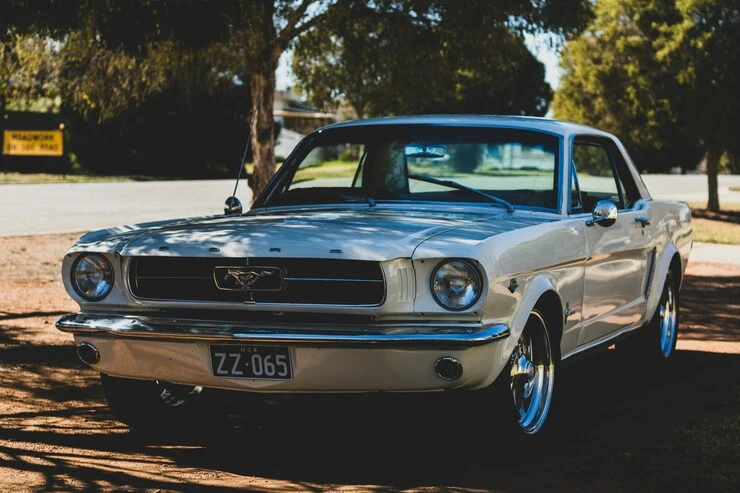
First Generation Mustang (1964–1973)
The original Mustang changed the automotive landscape overnight.
Available as a coupe, convertible, and later a fastback, buyers could customise their cars with a wide range of engines, trims, and options.
Early models featured a choice of engines ranging from a 170 cubic-inch straight-six to a 289 cubic-inch V8 producing up to 271bhp.
Distinctive styling cues included:
- Long bonnet
- Short rear deck
- Running horse grille emblem
- Triple-segment rear lights
The first-generation Mustang laid the foundation for one of the most successful performance car line-ups in automotive history.
Performance became an increasingly important part of the Mustang story during this era. Carroll Shelby’s GT350 arrived in 1965, followed by increasingly powerful Shelby and Ford performance versions that helped establish the Mustang’s long-running association with motorsport and high-performance V8 engines.
Second Generation Mustang (1974–1978)
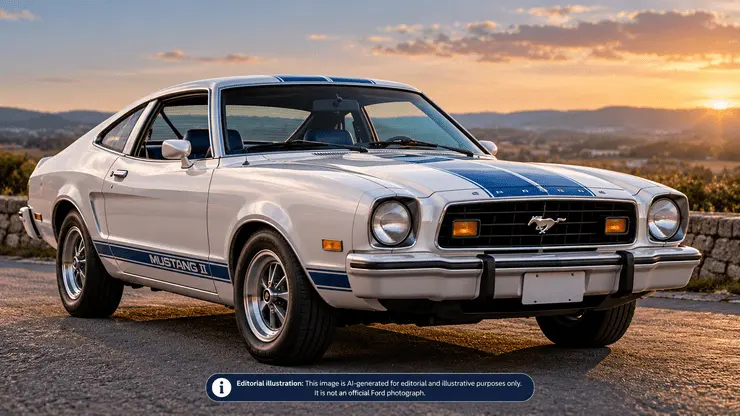
Introduced during the fuel crisis, the Mustang II was smaller, lighter, and more economical than its predecessor.
Built on a modified platform shared with the Ford Pinto, the second-generation Mustang focused on efficiency rather than outright performance.
Engine options included:
- 2.3-litre four-cylinder
- 2.8-litre Cologne V6
- Later V8 options
While enthusiasts often overlook the Mustang II, it proved commercially successful, helping Ford navigate a difficult period for performance cars.
The Cobra II package added distinctive stripes, spoilers and more aggressive styling. Although performance was modest compared with earlier V8 Mustangs, it helped maintain the model’s sporting image during an era shaped by fuel economy and changing emissions requirements.
Third Generation Mustang (1979–1993)
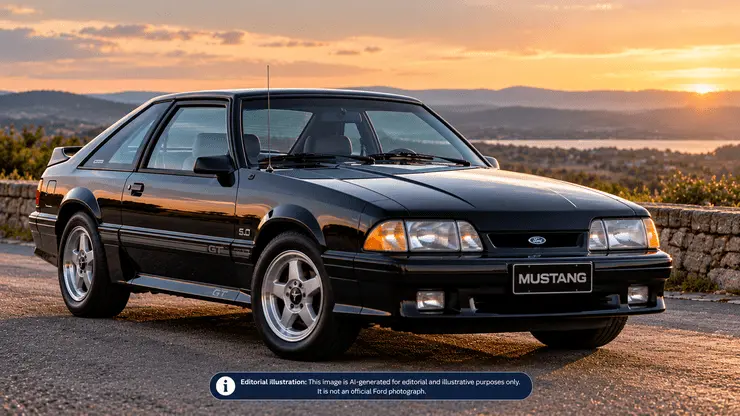
The arrival of the Fox-body Mustang marked a major turning point.
Built on Ford’s versatile Fox platform, the third-generation Mustang became one of the most popular performance cars of the 1980s.
Key highlights included:
- Improved handling
- Wider engine choices
- Lightweight construction
- Affordable performance
The introduction of fuel-injected V8 engines helped restore the Mustang’s performance credentials.
In 1993, the newly established Ford Special Vehicle Team introduced the Mustang SVT Cobra. Its 5.0-litre V8 produced a claimed 235bhp, providing a fitting high-performance finale for the Fox-body generation.
Today, Fox-body Mustangs remain hugely popular among enthusiasts thanks to their tuning potential and classic styling.
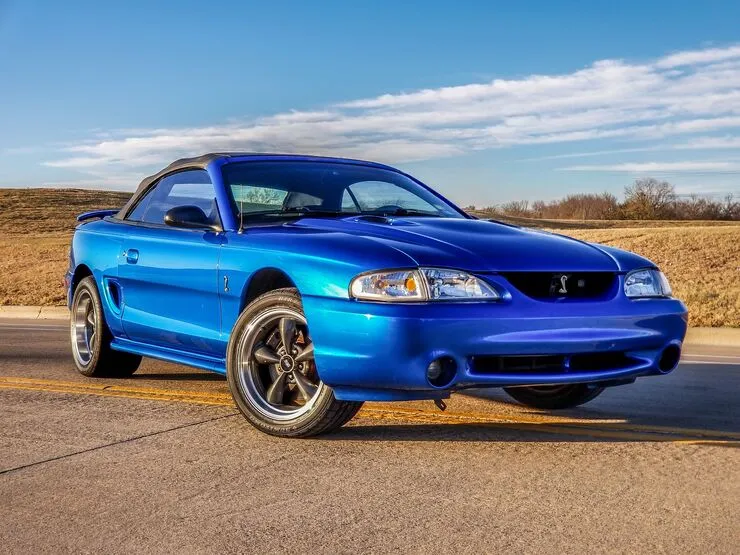
The fourth-generation Mustang introduced Ford’s “New Edge” design language and modernised the Mustang for a new generation of buyers.
Fourth Generation Mustang (1994–2004)
Key improvements included:
- More rigid chassis
- Updated suspension
- Improved safety features
- Refined interior
Performance versions became increasingly powerful throughout this generation. The SVT Cobra developed from the naturally aspirated models of the 1990s into the supercharged 2003–2004 “Terminator” Cobra, which produced a claimed 390bhp and became one of the most celebrated performance Mustangs of its era.
The 2000 Mustang Cobra R became one of the most extreme Mustangs ever built, featuring a naturally aspirated 5.4-litre V8 producing 385bhp.
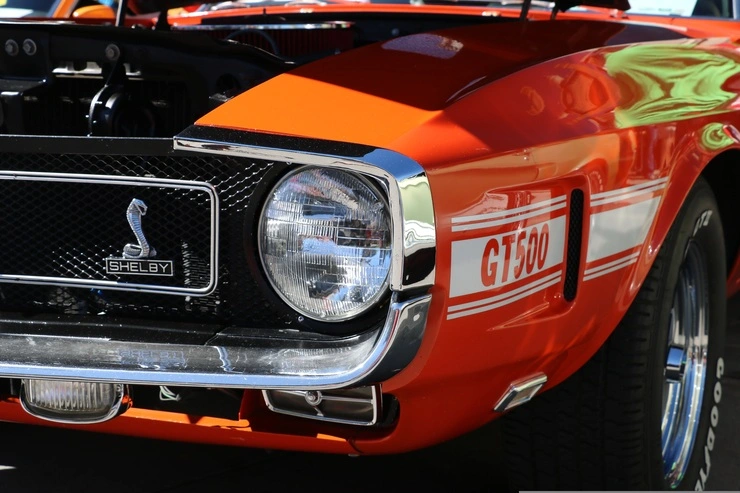
Fifth Generation Mustang (2005–2014)
The fifth-generation Mustang embraced retro styling, drawing heavy inspiration from the original 1960s model.
Its design featured:
- Classic fastback proportions
- Retro-inspired dashboard
- Aggressive front grille
- Modern performance technology
The return to classic styling proved hugely successful.
Performance versions such as the Shelby GT500 raised the bar even further, offering:
- Supercharged V8 power
- Up to 662bhp in later models
- Improved suspension and braking systems
The fifth-generation Mustang successfully blended heritage styling with modern engineering.
Sixth Generation Mustang (2015–2023)
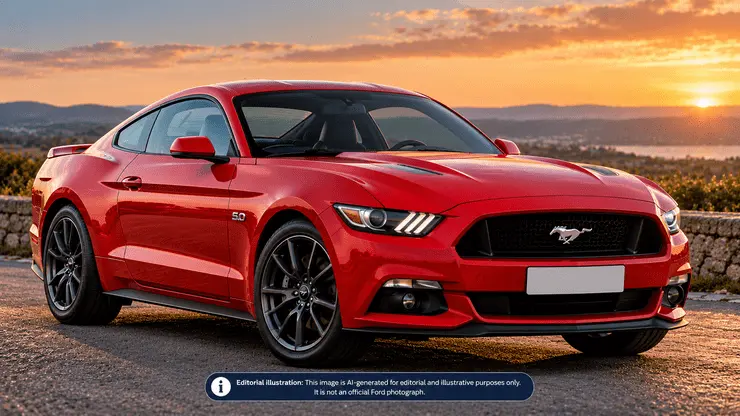
The sixth-generation Mustang marked the model’s transition into a truly global sports car.
For the first time, Ford officially sold the Mustang across Europe and many other international markets.
Buyers could choose between:
- 2.3-litre EcoBoost turbocharged four-cylinder
- 5.0-litre Coyote V8
Major improvements included:
- Independent rear suspension
- Enhanced interior quality
- Advanced driver assistance systems
- Improved refinement
The sixth generation was also particularly significant for UK buyers. For the first time, the Mustang was officially offered in right-hand-drive form, making Ford’s famous performance car much more accessible to British customers.
Seventh Generation Mustang (2024–Present)
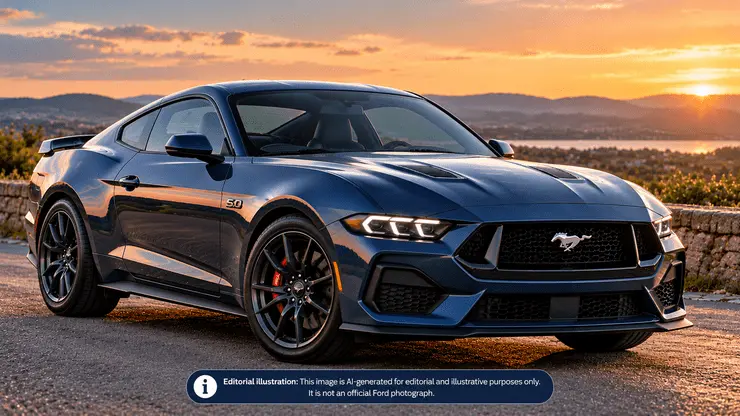
The seventh-generation Mustang continues the familiar formula while introducing updated styling, technology and performance.
In the UK, the Mustang is offered with Ford’s 5.0-litre V8, with models including the Mustang GT and the more performance-focused Dark Horse.
The new generation also introduced a significantly redesigned interior, including a large digital instrument display and central touchscreen, while retaining features that connect it to more than 60 years of Mustang heritage.
The Dark Horse takes the performance focus further with additional chassis, cooling and braking upgrades designed to make it more capable on both road and track.
The Mustang Mach-E: A New Chapter
The Mustang Mach-E took the famous name in a very different direction. Launched as an all-electric SUV, it is a separate model from the traditional Mustang coupe and convertible rather than a replacement for them.
Ford gave the Mach-E several Mustang-inspired design cues and positioned performance versions such as the Mach-E GT around the sporting character associated with the name. However, underneath, it represents a very different type of vehicle built around an electric powertrain and SUV body style.
Its arrival demonstrated how Ford was prepared to extend the Mustang name beyond the traditional sports car, while the continued development of the V8-powered Mustang shows that the two have followed separate paths within Ford’s range.
Why the Mustang Remains a Legend
For more than 60 years, the Mustang has remained relevant by continuously evolving while staying true to its core formula of style, performance, and accessibility.
Whether it’s a classic first-generation V8, a Fox-body favourite, a Shelby GT500, today’s seventh-generation Mustang or the electric Mach-E, the Mustang name continues to represent one of the most recognisable stories in performance-car history.
Sticking with the legend that is Ford, here’s some of the fastest Fords that we’ve seen throughout time.
Thinking About Parting With Your Current Car?
Whether you’re upgrading to a performance car, switching to electric, or simply changing vehicles, jamjar can help you sell your car quickly and easily.
Simply enter your registration number into our free online valuation tool to discover what your car could be worth today.