
If you’re buying or selling a used car, you’ll often see the words “full service history” used to describe it.
But what does a full service history actually mean?
In simple terms, a full service history is evidence showing that a vehicle has been serviced at the appropriate intervals throughout its life.
Traditionally, that evidence would have been a stamped service book. Today, it can be made up of several different types of physical and digital records.
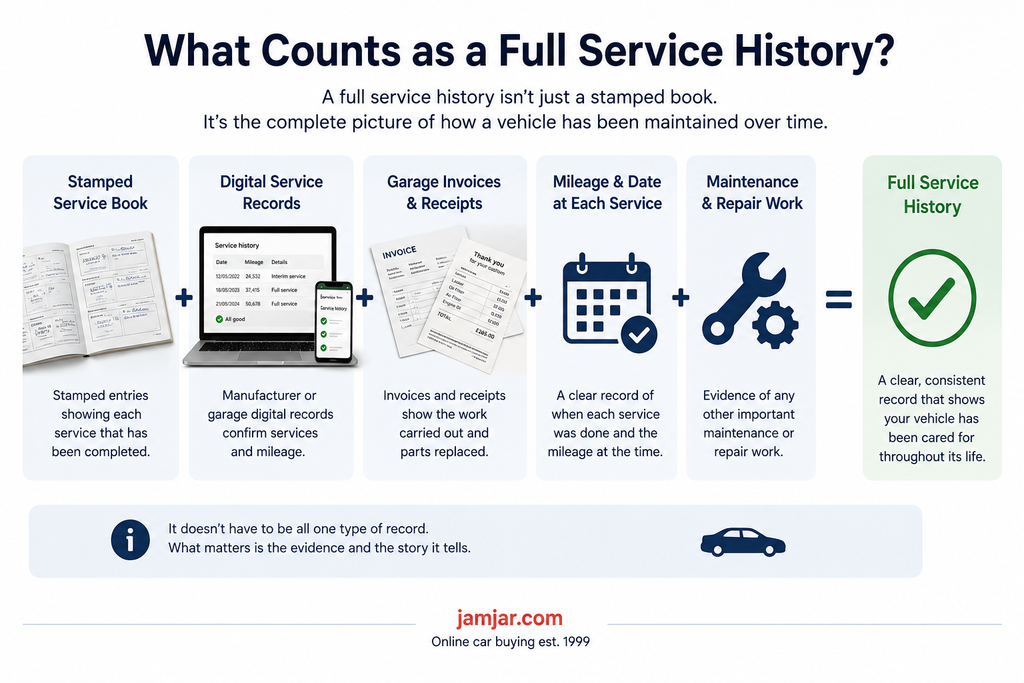
A car’s service history might include:
- a stamped service book
- digital service records
- garage invoices
- servicing receipts
- records from a manufacturer’s dealer network
- details of the mileage and date at each service
- evidence of maintenance or replacement work carried out
What matters is that the records help create a clear and consistent history of how the car has been maintained. For more help understanding what records to keep and how they fit together, visit our Service History & Vehicle Records guidance hub.
A physical service book can therefore still be useful even when some of the vehicle’s history is stored digitally.
Does full service history mean main dealer history?
No.
A car does not necessarily need to have been serviced exclusively by a manufacturer’s franchised dealer to have a full service history.
Independent garages can also service vehicles and provide valuable evidence of the work they have carried out.
For an owner, the important thing is to retain the documentation.
Invoices and receipts can show considerably more than a stamp alone, including the work completed, parts replaced, mileage and date.
That additional evidence can help create a much clearer picture of the vehicle’s maintenance over time.
What is the difference between full and partial service history?
A full service history should provide evidence covering the vehicle’s servicing throughout its life at the appropriate intervals.
A partial service history means some records are available, but parts of that history are missing.
For example, a car might have records for its first three years, nothing for the following two years, and then detailed records thereafter.
That doesn’t necessarily mean the car wasn’t maintained during the missing period.
It means there may not be enough surviving evidence to demonstrate what happened.
That’s an important distinction.
The maintenance itself matters — but when you’re establishing a vehicle’s history, the evidence matters too.
What if some service history is missing?
Missing records don’t automatically tell you that a car has been badly maintained.
Paper service books can be lost, invoices thrown away and digital records may be held by different garages or manufacturer systems.
If you’re trying to reconstruct a car’s history, it can be worth gathering together whatever evidence remains.
This could include old invoices and receipts, contacting garages that previously worked on the vehicle and checking available digital service records.
A car’s MOT history can also provide useful supporting information about recorded mileage and previous MOT tests, although an MOT record is not the same thing as a service history.
Why is a full service history useful?
A good service history can help both the current owner and somebody considering buying the vehicle.
It provides evidence of when the car has been maintained and can make it easier to understand what work has already been completed.
It may also help when the car is eventually sold.
A buyer who can see an organised maintenance history has more information on which to judge the vehicle than somebody looking at an otherwise similar car with little or no documentation.
This is why keeping service records isn’t only about remembering when the next service is due.
You’re gradually creating a record of the car’s life.
Does a full service history affect a car’s value?
Potentially, yes.
The condition, age, mileage, specification and market demand for a vehicle all contribute to your car’s value, so service history isn’t the only consideration.
However, a well-documented maintenance history can give a prospective buyer greater information about how a vehicle has been looked after.
We’re going to cover this properly in our separate guide:
How should you keep your car’s service history?
There isn’t one record that has to contain everything.
If you want a practical system for bringing everything together, our guide to organising your car’s service and maintenance records explains how to keep service books, invoices, receipts and digital records in one useful vehicle history.
Digital service records, a physical service book, garage invoices, receipts and other maintenance documentation can work together.
The important part is keeping the evidence rather than relying on yourself to find it years later.
Keeping your records organised as work is completed can make the vehicle’s history considerably easier to follow.
Keep a record as you go
Building a good service history is much easier when it’s done throughout your ownership rather than trying to reconstruct everything when it’s time to sell the car.
Keep dates, mileage, servicing information, invoices and receipts together wherever possible.
Whether those records are physical, digital or a combination of both matters less than maintaining a clear, useful history of the vehicle.
And if you’re still wondering whether keeping a traditional service book is worthwhile alongside today’s digital records, we’ve looked at that separately in our guide to whether car service books still matter.