
Catalytic converter theft remains a concern for UK motorists because these emissions-control devices contain valuable precious metals and can be removed quickly from underneath a vehicle.
Hybrid vehicles are often targeted because their catalytic converters can contain valuable metals and may experience less wear than those fitted to conventional petrol or diesel cars. Vehicles with greater ground clearance can also be easier for thieves to access.
In this guide, we explain why catalytic converters are stolen, which vehicles can be more vulnerable, how to reduce the risk and what to do if yours is taken.
For more information on vehicle safety and maintenance, check out our maintenance guidance hub.
Why are thieves stealing catalytic converters?
Catalytic converters contain valuable precious metals including:
- Platinum
- Palladium
- Rhodium
These metals help catalytic converters reduce harmful exhaust emissions, but their value also makes the components attractive to thieves.
Hybrid vehicles can be particularly vulnerable because their catalytic converters often experience less wear, while SUVs, vans and other vehicles with greater ground clearance can be easier to access from underneath.
Police guidance warns that a catalytic converter can sometimes be removed in less than a minute, which is why thieves often target vehicles that can be reached quickly and discreetly.
How can you prevent catalytic converter theft?
While no security measure is completely foolproof, there are several ways to reduce your chances of becoming a victim.
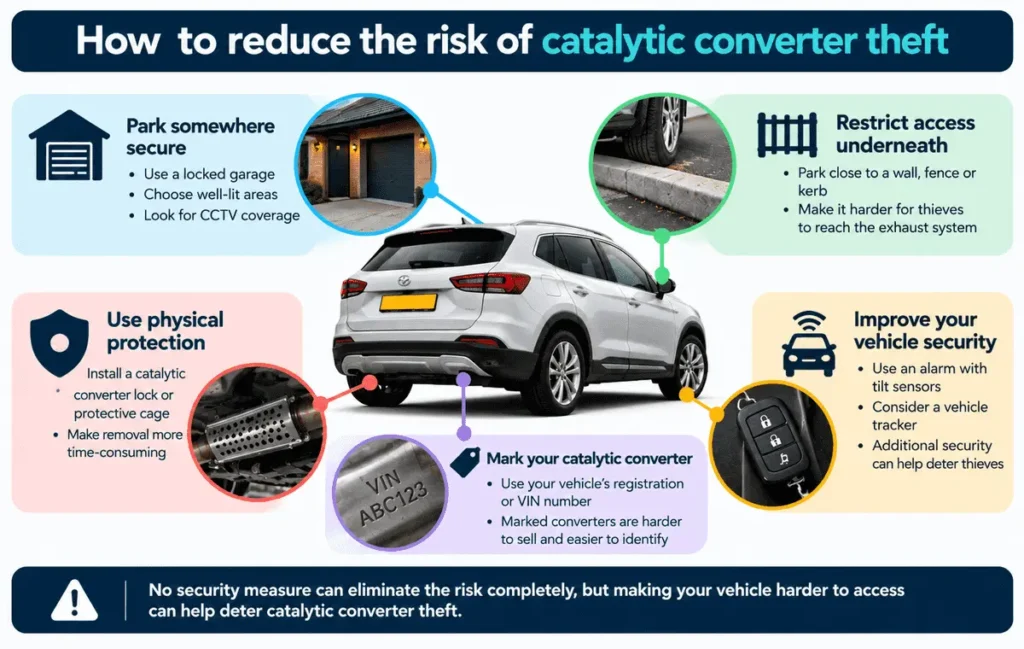
Park somewhere secure
Whenever possible:
- Park inside a locked garage.
- Use well-lit parking areas.
- Choose locations covered by CCTV.
If you’re parking on the driveway, installing motion-activated lighting can also act as a deterrent.
Make access more difficult
Parking close to walls, fences or kerbs can restrict access underneath your vehicle, making it harder for thieves to reach the exhaust system.
Install a catalytic converter lock or cage
Specially designed clamps and protective cages make removing the converter much more time-consuming.
Since thieves are usually looking for a quick getaway, anything that slows them down often encourages them to move on.
Mark your catalytic converter
Many garages offer security marking or engraving services using your vehicle’s registration or VIN number.
Marked converters are harder to sell and easier for police to identify if recovered.
Improve your vehicle security
Tilt sensors and upgraded vehicle alarms can alert you if someone attempts to jack up your car.
If you’re interested in additional vehicle security, you might find investing in a car tracker a good idea.
Which cars are most commonly targeted?
Although any vehicle fitted with a catalytic converter can potentially be targeted, some cars appear more frequently in police and insurance data than others.
Older hybrid models from Toyota, Lexus and Honda have historically been among the most vulnerable, including vehicles such as the Toyota Auris, Toyota Prius, Lexus RX, Honda Jazz and Honda CR-V.
Vans, SUVs and other vehicles with greater ground clearance can also be attractive to thieves because the exhaust system is easier to reach.
The exact vehicles most at risk vary by location and over time, so owners should not assume their car is safe simply because it does not appear on a particular list.
Is catalytic converter theft covered by insurance?
It depends on your policy.
If you have:
- Comprehensive insurance — catalytic converter theft may be covered, subject to the terms of your policy and your excess.
- Third-party only or third-party, fire and theft — cover may vary, so always check your policy wording.
If your converter is stolen, you should:
- Report the theft to the police.
- Contact your insurer.
- Obtain repair estimates from an approved garage.
Should you buy a car that has previously had its catalytic converter stolen?
Not necessarily—but you should investigate carefully.
Consider:
- Has the converter been replaced correctly?
- Is the replacement an approved part?
- Has any damage been caused to the exhaust system?
- Has the repair been professionally carried out?
A pre-purchase inspection by a qualified mechanic is always recommended.
Can you drive without a catalytic converter?
A car may still run without its catalytic converter, but it should not normally be driven in that condition.
Without a catalytic converter:
- Your vehicle becomes significantly louder.
- Harmful emissions increase.
- The car is likely to fail its MOT.
- You could invalidate your insurance.
- You may be committing an offence if emissions regulations aren’t met.
If your converter has been stolen, arrange repairs as soon as possible.
What should you do if your catalytic converter is stolen?
If you discover your converter has been removed:
- Report the theft to the police.
- Contact your insurer if you intend to make a claim.
- Avoid driving the vehicle unless you have been advised that it is safe to do so.
- Arrange for the exhaust system to be inspected for any additional damage.
- Obtain repair estimates from a reputable garage.
Protecting your vehicle
While no security measure can eliminate the risk entirely, combining secure parking with physical protection and vehicle security can make your car a much less attractive target.
How much does a catalytic converter cost?
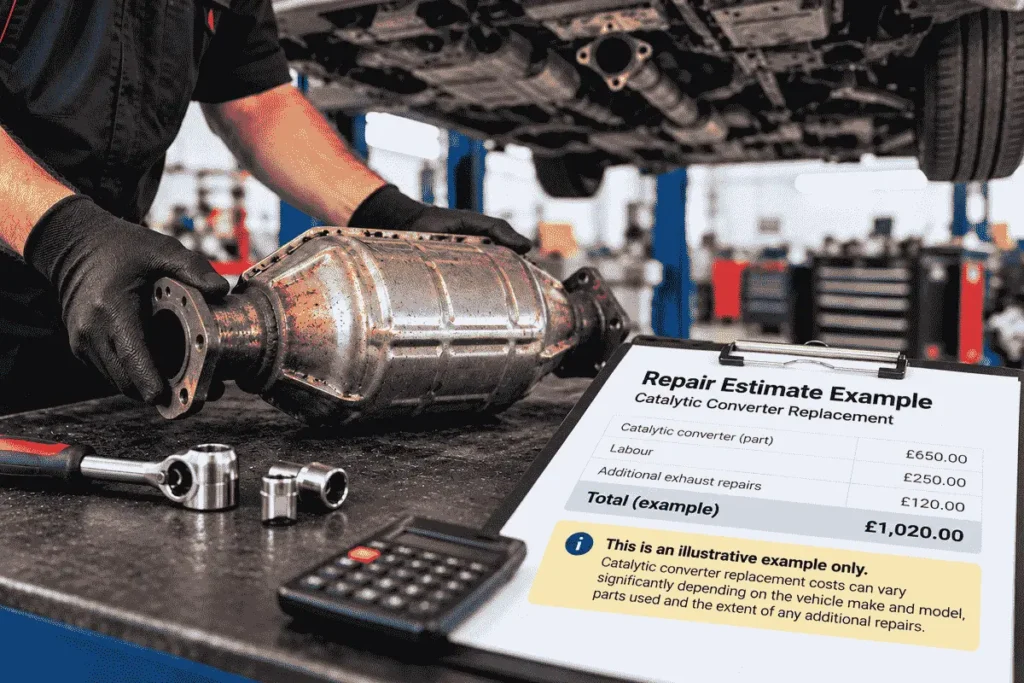
The cost of replacing a catalytic converter varies considerably depending on the make and model of the vehicle, the type of converter required and whether genuine manufacturer or aftermarket parts are used.
Labour costs and any additional exhaust damage caused during a theft can increase the overall repair bill significantly. Hybrid and specialist vehicles can also be more expensive to repair because of the type and value of the catalytic converter fitted.
If your catalytic converter has been stolen, you’ll also need to consider:
- Labour charges for fitting the replacement.
- Any additional damage caused to the exhaust system during the theft.
- Your insurance excess if you’re making a claim.
It’s always worth getting quotes from several reputable garages before authorising repairs.
Can a stolen catalytic converter be recovered?
Unfortunately, recovering a stolen catalytic converter is relatively uncommon. Once removed, stolen catalytic converters can be difficult to recover because they may quickly pass through illegal resale or scrap-metal channels.
However, police and insurers recommend reporting the theft immediately, as it helps identify crime hotspots and may assist with wider investigations into organised theft gangs.
If you’ve had your converter marked with your vehicle registration or VIN, recovery becomes slightly more likely, although prevention remains the best defence.
Final thoughts
Catalytic converter theft cannot be prevented completely, but making your vehicle harder to access can substantially reduce the opportunity for thieves. Secure parking, protective guards, converter marking and good vehicle security can all help.
If your catalytic converter is stolen, report the theft, contact your insurer and have the exhaust system checked for any additional damage before arranging repairs.
And if the cost of repairs is making you reconsider whether to keep the vehicle, it may also be useful to understand what your car is currently worth before deciding what to do next.
If you’re weighing up whether repairs are worthwhile before selling, our guide to maintenance issues that put buyers off explains which problems can matter most when it’s time to sell your car.
Value your car the easy way with Jamjar
Whether your car has become too expensive to maintain or you’re simply ready for something newer, Jamjar makes selling your car quick, simple and stress-free.
Compare offers from a trusted network of UK car buyers in one place, with:
- Free, no-obligation valuations
- Competitive offers from trusted buyers
- No hidden fees
- A fully online process
- Fast payment once your sale is complete
Whether your vehicle is nearly new or has covered plenty of miles, Jamjar helps you value your car quickly and for a fair price, without the hassle of negotiating privately.